
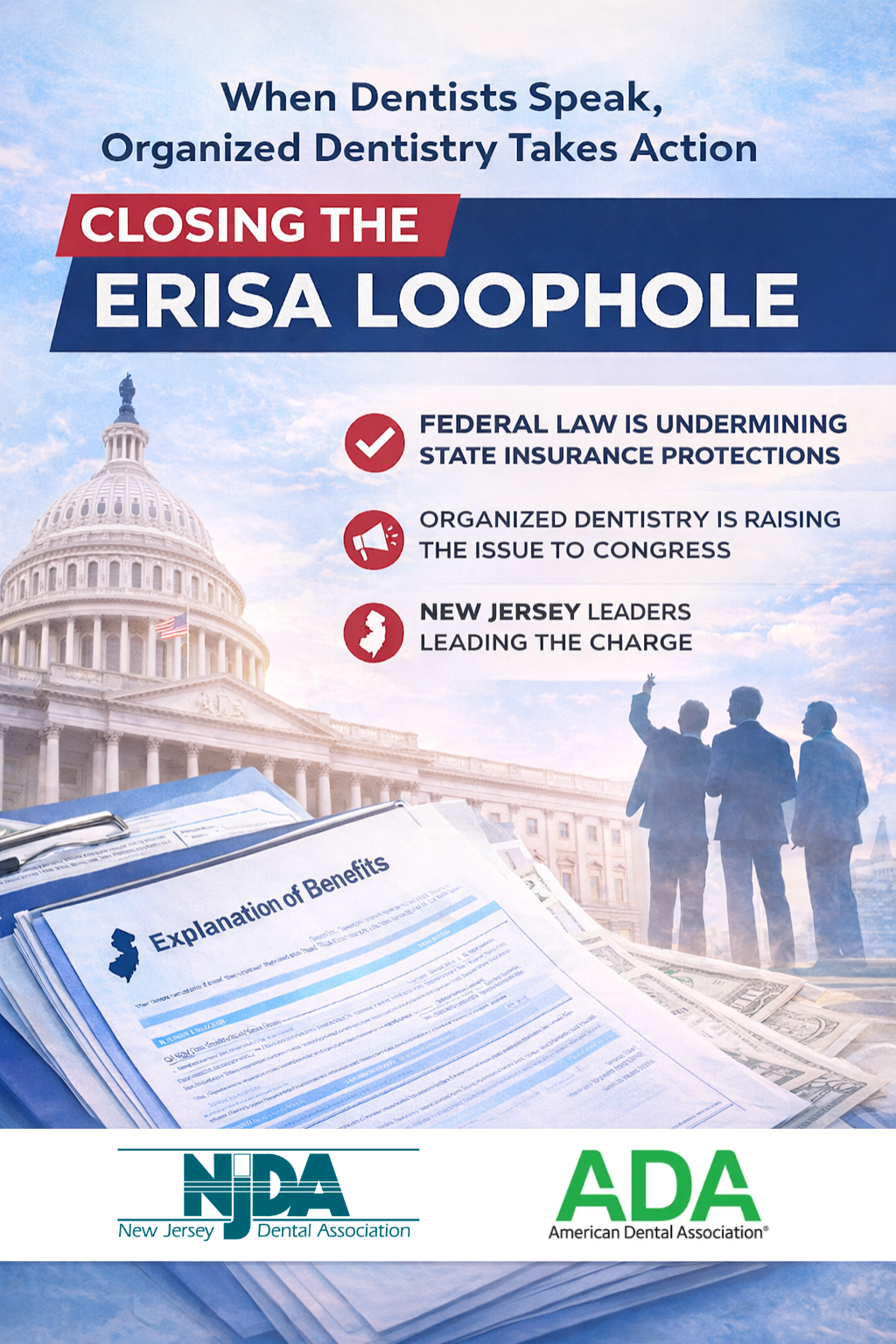
This Is What Advocacy in Organized Dentistry Looks Like: Closing the ERISA Loophole
A new patient calls your office.
They schedule an appointment. They arrive early. They complete their HIPAA forms, medical history, financial policy, and consent documents. Your team verifies insurance. Everything looks routine.
You evaluate the patient and discuss their treatment needs.
Let’s say it’s a core buildup and crown, or a periodontal maintenance visit beyond frequency limits, services that are commonly not covered by dental plans.
You have a clear conversation:
The service may not be covered
The patient agrees to pay out-of-pocket
You proceed with treatment
This is how dentistry is supposed to work: transparent, patient-centered, and based on mutual agreement.
And in New Jersey, the law supports that.
Under New Jersey law (N.J.S.A. 26:2S-33.1 and related statutes), dentists are permitted to:
Charge their usual and customary fees when coverage is uncertain, and
Refund patients later if insurance determines coverage differently
New Jersey has also enacted protections to prevent insurers from forcing dentists to accept discounted fees for non-covered services.
But then the Explanation of Benefits (EOB) arrives.
And everything changes.
When the Rules Change After the Fact
A real example highlights the issue:
A dentist receives an EOB showing a $400 adjustment for a service that was not covered under the patient’s plan.
The explanation states:
The plan is self-funded and governed by ERISA
The service is not a covered benefit
The dentist cannot bill the full fee
The patient’s responsibility is limited, not by agreement, but by the dental plan
Even though:
The patient agreed to pay
The service was not covered
New Jersey law would otherwise allow the dentist to charge their full fee
The adjustment is enforced.
This is the moment many dentists call NJDA.
Why This Keeps Happening
NJDA hears from members every week about the challenges of working with dental benefit payers.
Many of those frustrations involve self-funded plans governed by the Employee Retirement Income Security Act of 1974 (ERISA).
Members tell us:
Insurance cards and patient information often don’t distinguish whether a plan is self-funded or fully insured
Even when offices call carriers, representatives often cannot confirm plan type in real time
The EOB is often the first place the plan is identified as self-funded, after care has already been delivered
“Allowed fee for non-covered services” provisions force practices to take discounted fees simply because a plan is self-insured
These situations create confusion, administrative burden, and unfair financial pressure on dental practices and patients alike.
What Is ERISA and Why Does It Override State Law?
ERISA is a federal law that governs employer-sponsored benefit plans, including self-funded dental coverage.
Under ERISA §514 (29 U.S.C. §1144), federal law preempts state insurance regulation for self-funded plans.
That means:
New Jersey insurance laws and consumer protections often do not apply
State regulators cannot enforce state-specific transparency, reimbursement, or contracting rules
Dentists may not even know ERISA applies until the EOB is issued
This creates a structural gap:
State law allows dentists to bill appropriately
Federal law limits the state’s ability to regulate self-funded plans
A Growing Problem Across the Country
This is not a small issue.
Nearly 50% of dental plan enrollees nationwide are covered through self-funded plans regulated under ERISA .
States, including New Jersey, have passed laws addressing:
Non-covered services
Prior authorization
Prompt payment
Retroactive denials
These protections are designed to safeguard the doctor-patient relationship and promote fairness and transparency.
But when ERISA plans are allowed to bypass these laws, it creates a system where:
Patients receive inconsistent protections
Dentists face unpredictable rules
Access to care is affected
From Member Calls to Congressional Action
When these issues arise, members call NJDA.
And when we hear those concerns, we work with our colleagues across organized dentistry to ensure those voices reach policymakers.
NJDA and other state dental associations have been working with the American Dental Association to elevate these concerns at the federal level.
Now, that advocacy is taking shape in Congress.
On March 12, Representatives Jeff Van Drew, D.M.D., and Herb Conaway, M.D., both of New Jersey, introduced the Improving Dental Administration Act, legislation aimed at ensuring that state dental insurance reform laws apply to self-funded dental plans.
This legislation reflects the real experiences of dentists navigating ERISA plan loopholes and is an important step toward restoring fairness and transparency in dental benefits administration.
Why Political Action and Relationships Matter
This is what advocacy in organized dentistry looks like and why building relationships through political action is so important.
This moment did not happen overnight.
For years, NJDA members have:
Participated in Lobby Day visits
Shared real-world experiences with policymakers
Supported leaders through NJDPAC and ADPAC
Both sponsors of this bipartisan bill — Dr. Van Drew and Dr. Conaway — have long-standing relationships with organized dentistry. They have heard directly from dentists and understand the challenges facing the profession.
When they entered Congress, those relationships, and that understanding, continued.
And now, those relationships have turned into action.
Taking the Message to Washington
On March 23, 2026, a delegation of NJDA leaders were in Washington, D.C., during ADA’s Lobby Day meeting with members of Congress to ensure that New Jersey’s congressional delegation understands how important this legislation is. READ A RECAP OF NJDA'S EXPERIENCE AT LOBBY DAY
The message is simple:
New Jersey dentists are experiencing this every day and they need support for this bill.
This Is What Organized Dentistry Looks Like
A patient visit.
A claim.
A confusing EOB.
A call to NJDA.
And eventually, a bill in Congress.
Now Is the Moment
NJDA encourages members to engage with their congressional representatives across New Jersey to reinforce how important this issue is for dental practices and the patients we serve.
We will share additional information as the legislation progresses, including any ADA call-to-action opportunities.
Because this effort depends on one thing:
Dentists continuing to speak up.
For now, let’s keep the pressure up.
