
Add to:
Fall Membership Drive
Get a jump start on 2027 - join local, state, and national now with no payment until January!
Your Next Chapter Starts Here
Get expert guidance for selling, buying, or transitioning your dental practice. Schedule a complimentary consultation and take your next step with confidence.
Save Time & Money on Dental Compliance
Provide flexible online training for the entire team, create required HIPAA and OSHA manuals and documentation, access compliance resources and more for one low price. Through December 31, 2026, New Jersey dental offices can take advantage of Early Adopter pricing on the first year of ComplyBetter NJDA.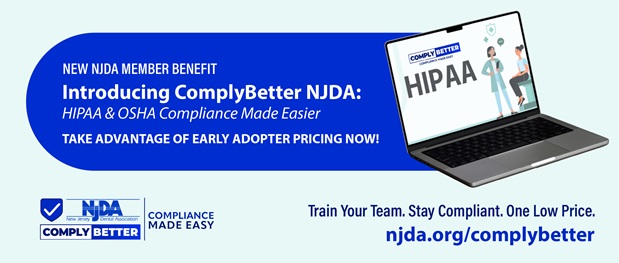
Make a Difference in Care
Help patients with special needs find a dental home. Join the NJDA’s Special Needs Provider List and connect your practice with patients and families seeking care. Sign up today.
Free CE for NJDA Members
NJDA members, don’t miss New Jersey Day at the Greater New York Dental Meeting on Sunday, November 29! GNYDM welcomes members and their staff to take advantage of special FREE CE opportunities! Registration now open!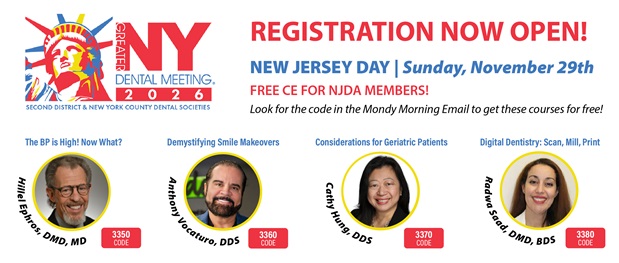
Raise a Glass to New Connections!
Join fellow early-career dentists for NJDA's Fall New Dentist Happy Hour- an evening of great conversations, new connections, and a well-deserved chance to unwind. Reconnect with classmates, expand your professional network, and enjoy a fun night with colleagues who understand the journey. We can't wait to see you there!
Don't Miss Session 3!
Join speaker Dilaine Gloege, CDA, CPC, for an informative session covering two common dental billing and coding challenges. Learn how to respond to insurer clawbacks and retroactive denials, and gain clarity on when and how to properly use CDT "By Report" codes with the documentation needed to support your claims.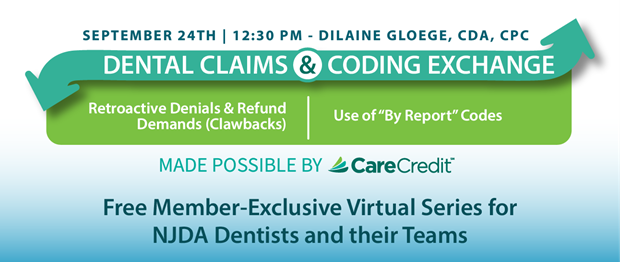
Helping Members Succeed
The New Jersey Dental Association is the voice of the dental profession and a strong proponent of oral health in the state. Members are part of a vibrant community of dentists encompassing 12 local dental societies as well as the American Dental Association. Members engage in educational programs, have access to dentist-centric relationships and tools to navigate the business of dentistry and their careers, as well as benefit from dedicated advocacy that protects the interests of the profession. The organization is run by member-dentists with the support of a team of professionals at NJDA Headquarters. NJDA members never practice alone!
UPCOMING EVENTS
Add to:
Add to:
DENTAL NEWS AND NOTES

A Comprehensive Cybersecurity Strategy for Dental Offices | Dental Technologies
Article sourced by NJDA PERK Provider: Dental Technologies- A secure network is essential in today’s cyber dental environment. Strong passwords, employee awareness, and phishing prevention help reduce the risk of data breaches.
As dental practices continue to embrace digital transformation, cybersecurity has become a critical concern. From patient records to payment processing, dental offices handle a vast amount of sensitive data that makes them attractive targets for cybercriminals. Implementing a strong cybersecurity strategy is essential to protecting patient privacy, maintaining regulatory compliance, and ensuring business continuity. Below is a comprehensive approach to cybersecurity, ranging from basic to advanced protections tailored for dental offices. In future articles, I will be doing a deeper dive into each one of these areas.
1. Establish a Strong Cybersecurity Foundation
Employee Training and Awareness
Human error is one of the leading causes of security breaches. Dental offices should provide ongoing training for staff to recognize phishing emails, suspicious links, and social engineering tactics. Employees should also understand the importance of strong passwords and how to manage them securely.
Enforce Strong Password Policies
Implement a password policy that requires:
- Unique passwords for each account
- A mix of upper- and lowercase letters, numbers, and symbols
- Multi-factor authentication (MFA) for accessing sensitive systems, including your practice management software and cloud storage.
Update Software and Hardware Regularly
Outdated software and hardware are vulnerable to cyberattacks. All systems, including practice management software, electronic health records (EHRs), operating systems, and network hardware, should be kept up to date with the latest security patches.
2. Implement Network Security Measures
Use a Secure Firewall and Antivirus Software
A firewall acts as a barrier between your office’s internal network and potential threats from the internet. Pairing this with reputable antivirus and anti-malware software helps prevent, detect, and remove malicious threats.
Segment Your Network
Separating office networks from guest Wi-Fi prevents unauthorized access to sensitive data. Ensure patient data and business systems operate on a secured, encrypted network, while guests connect to a separate, isolated Wi-Fi network.
Enable Data Encryption
Encryption ensures that even if data is intercepted, it cannot be read by unauthorized individuals. All patient records, emails, and financial transactions should be encrypted both in transit and at rest.
3. Protect Patient Data and Regulatory Compliance
HIPAA Compliance and Data Protection
Dental offices must adhere to the Health Insurance Portability and Accountability Act (HIPAA) regulations for protecting patient health information (PHI). This includes implementing security policies, monitoring access logs, and maintaining an incident response plan.
Restrict Access to Sensitive Data
Implement role-based access controls (RBAC), ensuring only authorized personnel can access specific data. Office staff should only have access to the information necessary for their roles.
4. Advanced Cybersecurity Strategies
Conduct Regular Security Audits and Risk Assessments
A thorough security audit identifies vulnerabilities before cybercriminals can exploit them. Conduct periodic risk assessments to evaluate security policies, access controls, and potential threats.
Implement Endpoint Detection and Response (EDR) Solutions
EDR tools provide real-time monitoring and automated responses to suspicious activities. These solutions help dental offices detect malware, ransomware, and unauthorized access attempts before they cause damage.
Use Secure Cloud Solutions
If your practice relies on cloud storage for patient records or backup solutions, choose a provider with strong security features, including end-to-end encryption and robust access controls.
Deploy a Zero Trust Security Model
Zero Trust assumes that no user or device should be automatically trusted. It requires continuous verification of user identities, strict access controls, and the principle of least privilege (only granting access to what is absolutely necessary).
5. Develop an Incident Response Plan
Even with the best security measures in place, breaches can still happen. A well-structured incident response plan should include:
- Steps for identifying and containing security incidents
- Notification procedures for affected patients and regulatory bodies (if required)
- Strategies for data recovery and business continuity
6. Backup and Disaster Recovery Planning
Implement Automated Backups
Regularly back up patient records, financial data, and critical business files. Store backups securely in an offsite or cloud-based location with encryption and access controls.
Test Backup Restorations
It’s not enough to back up data; dental offices must regularly test their ability to restore it to ensure business continuity in case of a cyberattack or system failure.
7. Partner with Cybersecurity Experts
Work with a Managed IT Provider
Many dental offices lack the in-house expertise to manage cybersecurity effectively. A managed service provider (MSP) specializing in dental IT can help with network security, compliance, and ongoing monitoring.
Cyber Insurance for Added Protection
Consider investing in cyber liability insurance to mitigate financial risks associated with data breaches, ransomware attacks, or HIPAA violations.
Conclusion
Cybersecurity should be a top priority for dental offices. By implementing a layered security strategy that includes employee training, network security, compliance measures, and advanced cybersecurity solutions, dental practices can significantly reduce their risk of cyber threats. Protecting patient data not only ensures compliance but also builds trust and safeguards the reputation of the practice. Investing in cybersecurity today will help secure the future of your dental office.
Photo by DC Studio
QUICK LINKS





Contact Us
Phone: 732-821-9400 or dial the Staff Directly
Fax: 732-821-1082 | Email: info@njda.org | Follow us @NJDentalAssoc
One Dental Plaza, North Brunswick, NJ 08902
