
Add to:
Member Input Needed
Learn about a proposed new approach to supporting insurance participation, reimbursement, credentialing, and more at a Regional Member Meeting this month.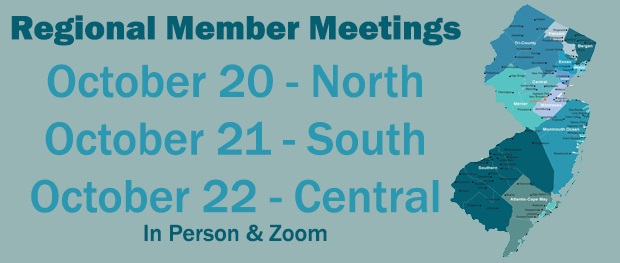
Innovation, Education & Connection at GNYDM 2026!
Explore the latest dental innovations, earn CE, network, and register FREE!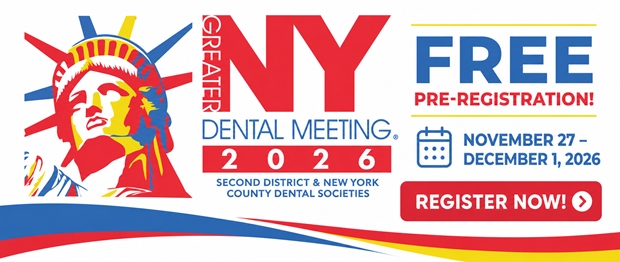
Fall Membership Drive
Get a jump start on 2027 - join local, state, and national now with no payment until January!
Save Time & Money on Dental Compliance
Provide flexible online training for the entire team, create required HIPAA and OSHA manuals and documentation, access compliance resources and more for one low price. Through December 31, 2026, New Jersey dental offices can take advantage of Early Adopter pricing on the first year of ComplyBetter NJDA.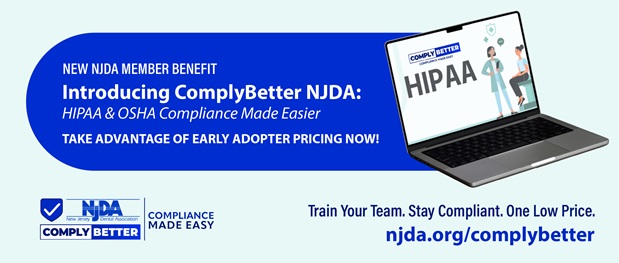
Make a Difference in Care
Help patients with special needs find a dental home. Join the NJDA’s Special Needs Provider List and connect your practice with patients and families seeking care. Sign up today.
Master Claim Appeals & Radiograph Coding
Join us November 17 at 1:00 PM for Session 4 of the Dental Claims & Coding Exchange! Dilaine Gloege, CDA, CPC, will cover claim denials and appeals plus radiograph coding and frequency limits to help your team navigate common claims and coding challenges.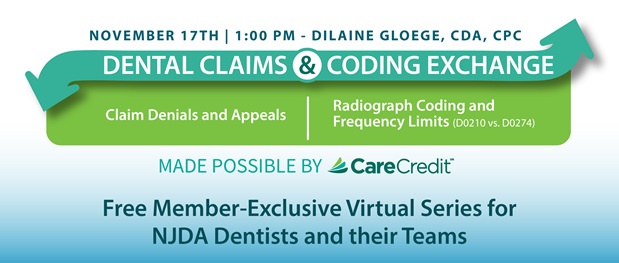
Helping Members Succeed
The New Jersey Dental Association is the voice of the dental profession and a strong proponent of oral health in the state. Members are part of a vibrant community of dentists encompassing 12 local dental societies as well as the American Dental Association. Members engage in educational programs, have access to dentist-centric relationships and tools to navigate the business of dentistry and their careers, as well as benefit from dedicated advocacy that protects the interests of the profession. The organization is run by member-dentists with the support of a team of professionals at NJDA Headquarters. NJDA members never practice alone!
UPCOMING EVENTS
Add to:
Add to:
DENTAL NEWS AND NOTES

Dental Support Organizations in New Jersey: How They Operate, How Ownership Works, and What the Wisconsin Delta Dental Case Means for Us
This Advocacy Insider post looks closely at how DSOs operate in NJ, what ownership structures are permitted, and how New Jersey’s Dental Practice Act differs from other states.
I. Why Everyone in New Jersey Is Talking About Wisconsin
In mid-2025, dentists across the country—and especially here in New Jersey—began asking a question that had previously felt hypothetical:
“Can a dental insurance company really buy a dental practice?”
That concern arose after Delta Dental of Wisconsin acquired Cherry Tree Dental, a multi-location dental group with roughly 25–30 practices. The acquisition was formally acknowledged by the Wisconsin Dental Association (WDA) and confirmed in filings that Delta Dental submitted to the Wisconsin Office of the Commissioner of Insurance. The American Dental Association (ADA) and WDA both raised significant public concerns, including:
- Whether insurers acquiring practices create conflicts of interest, since the same entity would both pay the claims and employ the dentists submitting those claims.
- Whether such vertical integration can distort treatment decisions, steer patients, or undermine the independence of clinicians.
- What happens to competition, reimbursement rates, and patient choice when an insurer becomes both the payer and a major provider.
Wisconsin is one of the few states that permits non-dentist ownership of dental practices outright. That legal structure makes insurer ownership permissible as long as administrative requirements are met.
This raised alarms among New Jersey dentists who understandably asked:
- “Could Delta—or any insurer—do this here?”
- “Would NJ law allow this kind of acquisition?”
- “What does this mean for DSOs and our own ownership rules?”
To answer these questions, we must look closely at how DSOs operate in NJ, what ownership structures are permitted, and how New Jersey’s Dental Practice Act differs sharply from states like Wisconsin.
II. What DSOs Are and How They Work
What Is a DSO?
A Dental Support Organization (DSO) is a separate business entity that provides non-clinical services to dental practices, such as:
- HR and staffing
- Billing and insurance administration
- Marketing and patient communications
- Equipment maintenance and IT
- Procurement and supply chain
- Facilities management
- Compliance and administrative support
A DSO's purpose is to allow dentists to focus on clinical care while the DSO runs the business infrastructure. DSOs may support dozens—or hundreds—of independently owned practices.
The ADA’s Position on DSOs
The American Dental Association does not oppose DSOs. Instead, the ADA provides guidance for dentists on:
- Understanding business services agreements
- Ensuring clinical autonomy remains with the licensed dentist
- Avoiding fee-splitting arrangements
- Knowing how DSOs may affect professional liability, employment, and financial structures
The ADA’s published resources emphasize that DSOs can be valuable if structured legally and ethically—but contracts must keep clinical decisions in the hands of dentists.
III. DSO Ownership Models
DSOs typically use one of several structures:
1. Pure Management Services Model
- Dentist owns the practice.
- DSO is paid a management fee.
- DSO provides staffing, IT, billing, etc.
2. Equity Partnership Model
- The DSO may own part of the practice entity (where state law allows).
- Dentists may become equity partners in the DSO or broader corporate group.
3. Practice Acquisition / “Invisible DSO” Model
- The DSO acquires the practice entity but keeps the local brand.
- Patients may not know the practice is part of a corporate network.
4. Hybrid or Joint Venture Models
- Shared ownership, shared governance, shared financial risk.
However, in New Jersey, many of these structures must be significantly modified because of how the state defines “practicing dentistry.”
IV. New Jersey’s Legal Framework: Why Our State Is Different
New Jersey has some of the strictest corporate-practice restrictions in the country when it comes to dentistry.
1. The Dental Practice Act – Prohibition on Corporate Practice
Under N.J.S.A. 45:6-12, a dentist may not practice dentistry:
- Under a corporate or trade name (with limited exceptions)
- As an agent, employee, or officer of any entity not owned and controlled by a licensed dentist
This is a traditional corporate practice of dentistry prohibition.
2. Broad Definition of “Practicing Dentistry”
N.J.S.A. 45:6-19 defines practicing dentistry to include:
- Acting as the manager, proprietor, operator, or conductor of a facility where dental operations occur
- Owning or controlling dental equipment
- Making that equipment available to others
- Employing or controlling dental auxiliary staff
This means a non-dentist entity that manages the business in a way that controls operations could be considered to be practicing dentistry illegally.
This is where DSOs must be extremely careful.
3. Fee-Splitting and Business Arrangement Rules
Under N.J.A.C. 13:30-8.13, dentists may not:
- Pay or receive referral fees
- Enter into fee-splitting agreements
- Structure business arrangements where compensation is tied to percentage of revenue or collections
DSOs operating in NJ therefore must use flat fees, cost-sharing agreements, or other structures not based on clinical volume or collections.
4. Regulation of Corporate/Industrial Clinics
Subchapter 4 of the dental regulations (N.J.A.C. 13:30-4) governs:
- Corporate clinics
- Industrial clinics
- Public/charitable dental service organizations
This framework reinforces that non-dentist entities must not control clinical decisions or the operation of a dental facility.
V. So Could Delta Dental or Other Insurance Companies Buy a Practice in New Jersey?
Realistically: No—not in the form it occurred in Wisconsin.
Here’s why:
1. Insurer Ownership Would Violate the Corporate Practice Doctrine
An insurance carrier—a non-dentist corporation—cannot own or control a dental practice under:
- N.J.S.A. 45:6-12 (no corporate practice)
- N.J.S.A. 45:6-19 (definition of “practicing dentistry” includes managerial control)
Owning a dental practice in NJ would almost certainly be interpreted as practicing dentistry without a license.
2. Percentage-Based Compensation or Steering Would Be Unlawful
Any attempt by an insurer-owned practice to structure compensation tied to clinical revenue, production, or referrals would violate N.J.A.C. 13:30-8.13.
3. Conflicts of Interest Would Trigger Regulatory Scrutiny
The NJ Division of Consumer Affairs, Board of Dentistry, and the Department of Banking & Insurance would all examine an insurer-practice ownership model as fundamentally incompatible with:
- Clinical autonomy
- Patient protection
- Anti-kickback/referral prohibitions
- Unfair business practices statutes
4. NJ jurisprudence emphasizes “true operational control”
New Jersey would look past the corporate paperwork and examine who is truly in control; if a non-dentist is effectively running the practice, the structure will not be upheld.
This makes Wisconsin-style vertical integration almost unworkable here.
VI. Why This Matters for DSOs and Independent Dentists
The Wisconsin case triggered attention because:
- If insurer-owned practices spread nationally, they may use market power to influence reimbursement.
- Independent dentists fear being placed at a competitive disadvantage.
- Some worry about insurer “steering” patients toward owned clinics.
- New Jersey dentists want assurance that similar acquisitions cannot quietly appear here.
The bottom line:
New Jersey’s statutory framework already functions as a natural safeguard against insurer-owned practice consolidation.
DSOs can operate in NJ—but only under carefully structured models that preserve full clinical control for licensees and comply with strict state law.
It is the intention of the New Jersey Dental Association to pay close attention to this issue and ensure the the right of clinical control remains in the hands of the dentist.
Appendix: Source References
New Jersey Statutes & Regulations
- N.J.S.A. 45:6-12 – Prohibition on practicing dentistry under a corporate name or as an agent/employee of a corporation.
- N.J.S.A. 45:6-19 – Broad definition of “practicing dentistry,” including acting as manager, proprietor, or operator.
- N.J.A.C. 13:30-8.13 – Permissible business arrangements; prohibition on fee-splitting and referral fees.
- N.J.A.C. 13:30-4.1 et seq. – Rules governing industrial and corporate dental clinics.
ADA Sources
- ADA – “Business Services Agreements with DSOs: What a Dentist Should Know.”
- ADA – “Practice Modalities and DSO Trends” (Health Policy Institute).
- ADA Public Statement on Delta Dental of Wisconsin’s Acquisition of Cherry Tree Dental (2025).
Wisconsin Sources
- Wisconsin Office of the Commissioner of Insurance filings regarding Delta Dental of Wisconsin corporate restructuring (2025).
- Wisconsin Dental Association statements (2025) regarding Delta’s acquisition.
10. Local Madison/Green Bay media coverage confirming the legality of insurer ownership of Cherry Tree Dental under Wisconsin law.
Industry Context
11. TAG / Aspen Dental public descriptions of practice ownership and DSO support structure.
12. Articles and compliance advisories summarizing New Jersey’s corporate practice doctrine and fee-splitting rules (various legal and dental practice management publications).

QUICK LINKS




Contact Us
Phone: 732-821-9400 or dial the Staff Directly
Fax: 732-821-1082 | Email: info@njda.org | Follow us @NJDentalAssoc
One Dental Plaza, North Brunswick, NJ 08902
