
Add to:
Member Input Needed
Learn about a proposed new approach to supporting insurance participation, reimbursement, credentialing, and more at a Regional Member Meeting this month.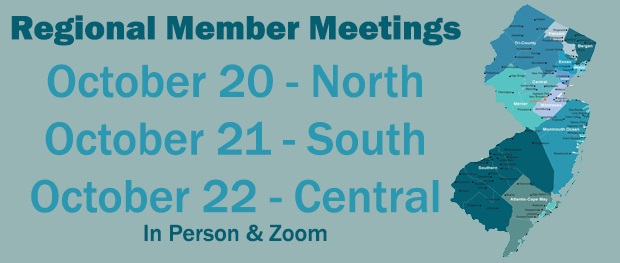
New Member Benefit Coming Soon
NJDA is excited to announce a new member benefit at the November 4 House of Delegates Meeting… watch this short video (0:45) for a hint!
Innovation, Education & Connection at GNYDM 2026!
Explore the latest dental innovations, earn CE, network, and register FREE!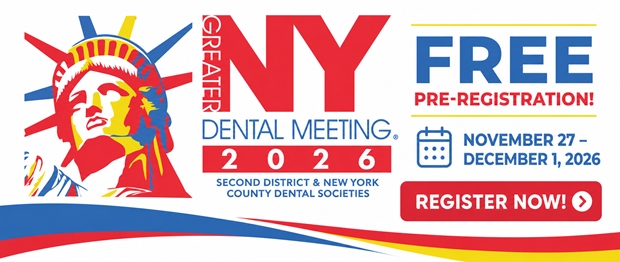
Fall Membership Drive
Get a jump start on 2027 - join local, state, and national now with no payment until January!
Save Time & Money on Dental Compliance
Provide flexible online training for the entire team, create required HIPAA and OSHA manuals and documentation, access compliance resources and more for one low price. Through December 31, 2026, New Jersey dental offices can take advantage of Early Adopter pricing on the first year of ComplyBetter NJDA.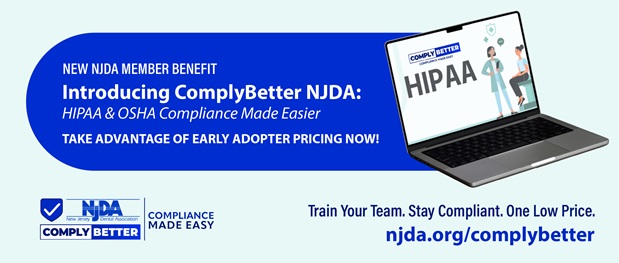
Make a Difference in Care
Help patients with special needs find a dental home. Join the NJDA’s Special Needs Provider List and connect your practice with patients and families seeking care. Sign up today.
Master Claim Appeals & Radiograph Coding
Join us November 17 at 1:00 PM for Session 4 of the Dental Claims & Coding Exchange! Dilaine Gloege, CDA, CPC, will cover claim denials and appeals plus radiograph coding and frequency limits to help your team navigate common claims and coding challenges.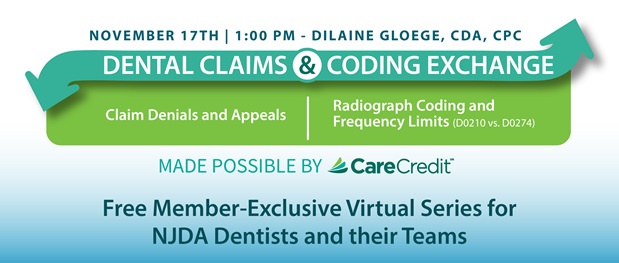
Helping Members Succeed
The New Jersey Dental Association is the voice of the dental profession and a strong proponent of oral health in the state. Members are part of a vibrant community of dentists encompassing 12 local dental societies as well as the American Dental Association. Members engage in educational programs, have access to dentist-centric relationships and tools to navigate the business of dentistry and their careers, as well as benefit from dedicated advocacy that protects the interests of the profession. The organization is run by member-dentists with the support of a team of professionals at NJDA Headquarters. NJDA members never practice alone!
UPCOMING EVENTS
Add to:
Add to:
DENTAL NEWS AND NOTES
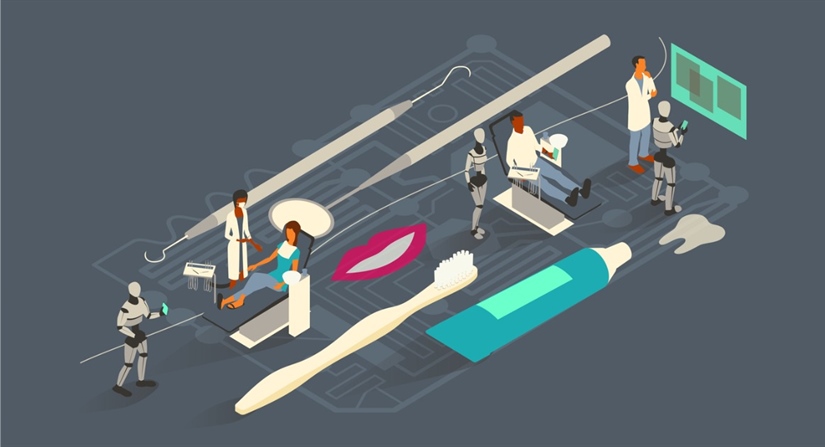
Navigating the Risks of AI-Enhanced Dentistry
The integration of AI into dentistry is an exciting advancement that holds promises of improved patient outcomes and streamlined operations. TDIC’s Risk Management analysts explain the risks associated with AI use and share tips for mitigating those risks.
Artificial intelligence offers innovative solutions for diagnosis, treatment planning and patient management in dentistry. Its integration also brings forth risks that dentists must be vigilant about to ensure patient safety and trust while minimizing their exposure to liability. The Dentists Insurance Company’s Risk Management Advice Line analysts point out that understanding these risks and adopting best practices to mitigate them is crucial.
Understanding AI
AI applications in dentistry range from AI-powered imaging systems to robotic surgical assistants. Have you integrated any of these common or emerging uses in your practice yet?
Common uses:
- Diagnostics and imaging: AI algorithms can analyze dental images like radiographs and 3D scans to identify dental caries, cancerous lesions and other abnormalities with high accuracy.
- Treatment planning AI can help to create precise treatment plans by analyzing patient data, leading to efficient and personalized dental care.
- Automated scheduling: AI systems can manage appointments, reducing no-shows and optimizing schedules for patients and dental staff.
- Patient engagement: AI-powered chatbots and virtual assistants can provide patients with instant responses to inquiries, improving responsiveness and service satisfaction.
Emerging uses:
- Predictive analytics: AI can predict oral health issues before they arise by analyzing patterns in data, assisting in anticipating potential complications and facilitating preventive care.
- AI-powered robotics: Advanced robotic systems can assist in delicate procedures like ideal dental implant positioning, ensuring precision and reducing procedure time.
- Teledentistry: AI can support online consultations, enabling remote diagnostics and consultations and expanding access especially to rural areas.
Key Risks of AI in Dentistry
Each of these technologies has the potential to significantly enhance diagnostic precision and treatment outcomes. Yet, each comes with its own set of challenges.
Data privacy concerns. AI systems require vast amounts of patient data to learn and function effectively. This can raise significant data privacy and security issues, making sensitive patient information vulnerable to breaches.
Diagnostic errors. While AI can enhance diagnostic capabilities, it's not infallible. If AI is used in diagnosis or treatment planning, the dentist must ensure that the AI recommendations meet the established standard of care to avoid potential liability. Reliance on AI for diagnosis without proper clinician input can lead to errors due to misinterpretation by the AI algorithms or due to biases in the data used to train the AI.
Algorithm bias. AI tools may exhibit bias if trained on nonrepresentative datasets, leading to unintended racial or ethnic disparities in treatment outcomes. Without diverse data training sets, providing fair treatment options for all patient demographics may be difficult.
Lack of human oversight. Overreliance on AI systems might lead to a lack of necessary human oversight. Dentists must remember that AI is a tool to assist — not replace — their professional judgment.
Ethical and legal implications. The use of AI in dentistry comes with ethical considerations, such as transparency about the use of AI technologies in patient care. Additionally, liability in cases of malpractice involving AI decisions is a legal gray area.
Integration and usability issues. Integrating AI systems into existing dental practice workflows can be challenging. There might be a steep learning curve, or AI systems may not seamlessly integrate with existing technologies.
Mitigating AI-Related Risks
AI's potential to improve patient care and optimize dental processes is immense. However, successful integration relies on the ability to manage associated risks effectively.
To reduce the possibility of malpractice claims related to AI use, consider these strategies:
- Strengthen data security measures. Invest in advanced cybersecurity solutions to protect patient data. Regular audits and compliance with HIPAA and other relevant standards are necessary to safeguard privacy.
- Train and educate. Continuous training on AI tools is essential. Ensure that all members of the dental practice team are well-versed in interpreting AI outputs and understanding the system's limitations. Cross-disciplinary collaboration involving technologists and clinicians can bridge knowledge gaps.
- Maintain human oversight. Treat AI as an advisory tool. Regularly verify AI-generated insights with traditional diagnostic methods and clinical judgment. Establish protocols for human intervention whenever AI tools flag unusual patterns or anomalies.
- Establish clear ethical guidelines. Develop and adhere to ethical guidelines for AI use, ensuring transparency with patients regarding AI involvement in their care. Obtain informed consents that explicitly cover AI use.
- Clarify legal responsibilities. Work with legal experts to define clear liability boundaries for your practice. Establishing protocols for AI use, including decision-making and documentation, can clarify responsibilities and reduce legal uncertainties.
- Integrate thoughtfully. Approach AI integration with careful planning. Involve IT professionals from the start and ensure interoperability with existing systems to minimize disruption and enhance usability.
The Future of AI in Dentistry
The integration of AI into dentistry is an exciting advancement that holds promises of improved patient outcomes and streamlined operations. AI has the potential to be a strong ally in delivering the highest standard of dental care — one that augments human expertise rather than diminishes it.
However, dental professionals must adopt robust strategies to mitigate potential new risks while embracing technological advancement. Through diligent oversight, education and compliance, dentists can embrace practice-changing innovation.
When questions or concerns about emerging technologies or other practice challenges arise, consult TDIC’s Risk Management Advice Line.
TDIC’s Risk Management Advice Line is a benefit to TDIC policyholders. To schedule a consultation with an experienced Risk Management analyst, visit tdicinsurance.com/RMconsult or call 877.269.8844.

QUICK LINKS







Contact Us
Phone: 732-821-9400 or dial the Staff Directly
Fax: 732-821-1082 | Email: info@njda.org | Follow us @NJDentalAssoc
One Dental Plaza, North Brunswick, NJ 08902
