
Add to:
Member Input Needed
Learn about a proposed new approach to supporting insurance participation, reimbursement, credentialing, and more at a Regional Member Meeting this month.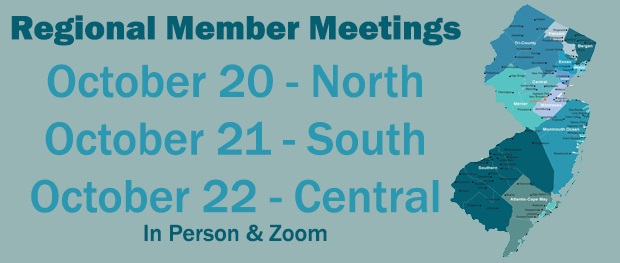
Innovation, Education & Connection at GNYDM 2026!
Explore the latest dental innovations, earn CE, network, and register FREE!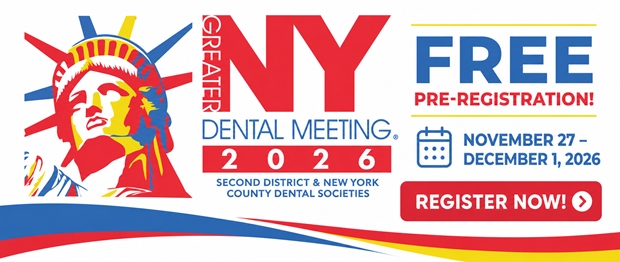
Fall Membership Drive
Get a jump start on 2027 - join local, state, and national now with no payment until January!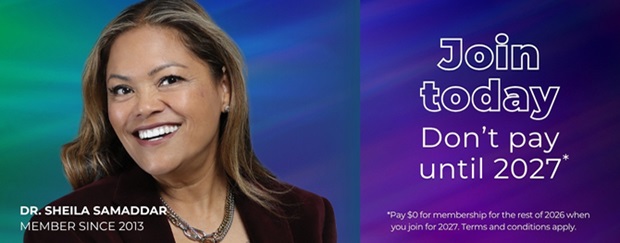
Save Time & Money on Dental Compliance
Provide flexible online training for the entire team, create required HIPAA and OSHA manuals and documentation, access compliance resources and more for one low price. Through December 31, 2026, New Jersey dental offices can take advantage of Early Adopter pricing on the first year of ComplyBetter NJDA.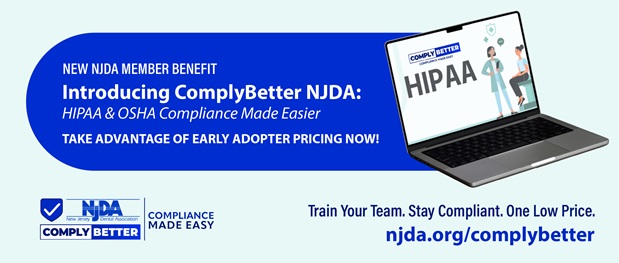
Make a Difference in Care
Help patients with special needs find a dental home. Join the NJDA’s Special Needs Provider List and connect your practice with patients and families seeking care. Sign up today.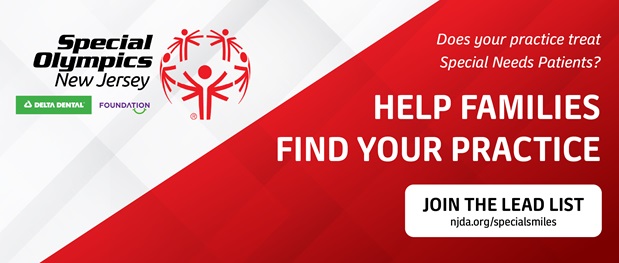
Master Claim Appeals & Radiograph Coding
Join us November 17 at 1:00 PM for Session 4 of the Dental Claims & Coding Exchange! Dilaine Gloege, CDA, CPC, will cover claim denials and appeals plus radiograph coding and frequency limits to help your team navigate common claims and coding challenges.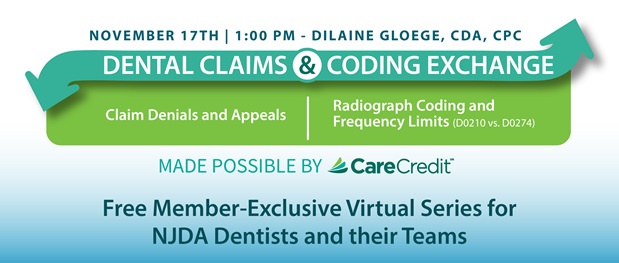
Helping Members Succeed
The New Jersey Dental Association is the voice of the dental profession and a strong proponent of oral health in the state. Members are part of a vibrant community of dentists encompassing 12 local dental societies as well as the American Dental Association. Members engage in educational programs, have access to dentist-centric relationships and tools to navigate the business of dentistry and their careers, as well as benefit from dedicated advocacy that protects the interests of the profession. The organization is run by member-dentists with the support of a team of professionals at NJDA Headquarters. NJDA members never practice alone!
UPCOMING EVENTS
Add to:
Add to:
DENTAL NEWS AND NOTES

Coverage Isn't Access: What New Jersey Employers and Employees Should Know About Dental Benefits
Most New Jersey employer dental plans are governed by federal law that exempts them from state patient protections. Here is what that means for your business and your employees, plus practical guidance for getting more out of the coverage you already pay for.
Most New Jersey employer dental plans are governed by federal law that exempts them from state patient protections. Here is what that means for your business and your employees, plus practical guidance for getting more out of the coverage you already pay for.
If you offer dental coverage to your employees, you have probably noticed the disconnect. Premiums climb every year. The benefit does not seem to keep pace. Annual maximums generally sit at $1,000 to $1,500, figures largely unchanged since the 1980s. By mid-year, many employees hit that cap and face the same out-of-pocket barrier as someone with no coverage at all. Significant shares of insured adults delay or skip dental care due to cost, even when they have a plan. (Source: ADA Health Policy Institute)
This is the gap between coverage and access. Coverage is on paper. Access is what actually happens at the dental chair. For most New Jersey workers, the two do not line up.
There is a structural reason for that, and the reason has a name.
What ERISA Does (and Doesn't Do)
The Employee Retirement Income Security Act of 1974, known as ERISA, is the federal law that governs employer-sponsored benefit plans. Its original purpose was reasonable: set a baseline for benefits across state lines so multi-state employers would not have to navigate fifty different sets of rules. The unintended consequence, half a century later, is that ERISA pre-empts most state patient protections from reaching the majority of employer-sponsored dental plans.
The mechanism: most employer-sponsored dental plans in New Jersey are self-funded, meaning the employer pays claims directly (often using an insurer as a third-party administrator) rather than buying a fully insured product. Self-funded plans fall under ERISA. ERISA-governed plans are not required to follow most state insurance laws.
The NJ Protections That Don't Reach Your Plan
Over the past several years, New Jersey has built a meaningful set of patient protections in dental care:
A prompt-payment law requiring carriers to pay clean claims on time.
A 2023 law (P.L. 2023, c.247) restricting insurance carriers from defaulting providers into virtual credit card payments, which carry processing fees that erode reimbursement.
Network leasing transparency rules requiring provider consent when networks are leased to third parties.
These protect patients and providers in fully insured plans. They do not apply to ERISA-governed self-funded plans. That means a dentist treating two patients side by side, one with a fully insured NJ plan, one with an ERISA self-funded plan, is operating under two different sets of rules. The patient with the ERISA plan has fewer protections, even though they and their employer may be paying just as much.
Why This Matters to Your Business
Oral health drives workforce productivity. Untreated dental pain shows up as missed workdays, reduced output, and emergency room visits. An estimated 45,000 New Jersey residents visit emergency departments each year for preventable dental conditions, visits that often resolve nothing while costing everyone, employers and the state alike. (Source: CareQuest Institute, 2022)
There is also a direct small-business connection. New Jersey's dental practices generate $17.9 billion in economic output and support 95,600 jobs statewide, most of that flowing through small healthcare businesses of three to fifteen employees. Those practices are the access infrastructure. When the economics of delivering covered care break down, through frozen benefit caps, administrative burden, or reimbursement that does not keep pace with cost, the practices that serve your community come under pressure too. (Source: ADA Health Policy Institute, 2022)
NJDA frames the access challenge as a two-system problem: workforce capacity and insurance economics have to be addressed together. Fixing one without the other will not restore access.
Practical Guidance: Getting More from the Coverage You Already Have
Whether you are an employer choosing a plan or an employee using one, the same set of questions and habits can make a meaningful difference. The information below works for both: employers can use it to evaluate plans and to brief their workforce; employees can use it before booking an appointment and at the dental chair.
Understand what you actually have
Know whether your plan is fully insured or self-funded. Your benefits broker or HR department can clarify. This determines what state patient protections apply to your plan.
Know your annual maximum and how much remains in the calendar year. Most plans cap benefits at $1,000 to $1,500 annually.
Know your plan year. Calendar year and plan year are not always the same. The reset date affects when your maximum refreshes.
Know what counts toward the maximum. Preventive care, including cleanings, exams, and X-rays, is often covered at 100% and does not always count against your annual cap. Restorative care (fillings, crowns, root canals) does.
Ask whether unused benefits roll over. Most plans do not allow this, but a few do.
Before scheduling treatment
Confirm the practice is in-network for your specific plan, not just the carrier name. Network leasing means a dentist can be in-network for some employers under the same carrier and not others.
Ask whether the plan requires pre-authorization for any anticipated work, and whether the practice will submit it on your behalf.
Request a written treatment plan with itemized costs before agreeing to any procedure beyond routine preventive care.
Ask which procedures are covered, partially covered, and not covered under your plan.
Watch for plan design details that affect cost
Ask whether any recommended procedure has a "downgrade" clause, where the plan only pays for a less-expensive alternative material (for example, an amalgam filling rather than a composite). The price difference is yours to cover.
Ask whether the practice offers a self-pay rate or a membership plan. In some cases, especially after your annual maximum is hit, paying out of pocket may be more cost-effective than going through insurance.
If your dentist recommends extensive work, ask whether it can be sequenced across two calendar years. Splitting treatment can let you use two annual maximums instead of one.
If you are an employer briefing your workforce
Encourage employees to use their preventive benefits. Cleanings and exams are usually free, and they prevent the bigger costs that hit the annual maximum.
Remind employees that "covered" does not always mean "fully paid." Coinsurance, deductibles, and downgrade clauses can leave significant out-of-pocket costs.
Provide a simple summary of plan basics at open enrollment, including annual maximum, plan year reset date, and what counts as preventive vs. restorative, so employees can plan around them.
Consider whether your current plan design is the right one. Plans with higher annual maximums, separate preventive limits, or rollover features may cost slightly more in premium but reduce the access gap.
What Reform Could Look Like
Better individual habits help. They do not close the structural gap. NJDA is advocating for a set of policy concepts that would make coverage actually mean access for employees, employers, and the dental practices that serve them. Four ideas at the center of the conversation:
Accountability for where premium dollars go. Establish dental loss ratio reporting in New Jersey, with a minimum threshold of 85 percent. The principle is simple: 85 cents of every premium dollar should go to patient care, not administration. Medical insurance follows this standard under federal law. Dental does not.
Restoring competitive balance in dental contracting. Allow dental practices to engage with carriers on non-fee matters, including prior authorization criteria, utilization management, payment timing, credentialing standards, and contract documentation, through a state-supervised framework. Practices today are price-takers; carriers set terms unilaterally. This concept restores a voice for the small businesses that deliver care, and protects the patient-provider relationship from administrative overreach.
Sound regulation of artificial intelligence in dental care decisions. AI tools are increasingly used by dental plans to evaluate claims, determine medical necessity, and approve or deny care. Sound regulation should ensure that decisions about your dental care are made by humans, with AI as a support tool, not a substitute. The patient-provider relationship requires clinical judgment that algorithms cannot replicate.
Administrative transparency on dental plans. Clearer disclosure of how plans work, including network leasing arrangements, downgrade clauses, what is and is not covered before care is delivered, and the actual annual maximum in real purchasing power terms. Patients and employers should be able to evaluate what they are paying for without needing a benefits attorney to translate.
Stay Connected
If you have questions about how these issues affect your specific plan, your benefits broker is a starting point. If you are interested in supporting NJDA's advocacy work or have a story to share about how dental coverage has, or has not, worked for your business or your family, we want to hear from you. Contact Director of Advocacy and Health Affairs Orville Morales at NJDA via email at omorales@njda.org.
QUICK LINKS




Contact Us
Phone: 732-821-9400 or dial the Staff Directly
Fax: 732-821-1082 | Email: info@njda.org | Follow us @NJDentalAssoc
One Dental Plaza, North Brunswick, NJ 08902
