
Add to:
Member Input Needed
Learn about a proposed new approach to supporting insurance participation, reimbursement, credentialing, and more at a Regional Member Meeting this month.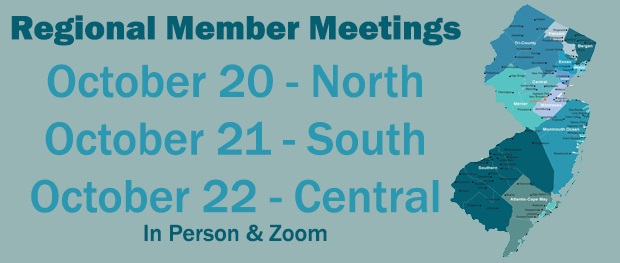
Innovation, Education & Connection at GNYDM 2026!
Explore the latest dental innovations, earn CE, network, and register FREE!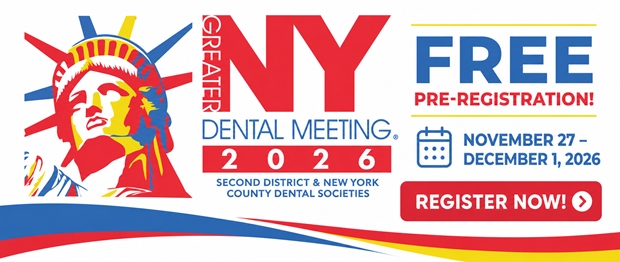
Fall Membership Drive
Get a jump start on 2027 - join local, state, and national now with no payment until January!
Save Time & Money on Dental Compliance
Provide flexible online training for the entire team, create required HIPAA and OSHA manuals and documentation, access compliance resources and more for one low price. Through December 31, 2026, New Jersey dental offices can take advantage of Early Adopter pricing on the first year of ComplyBetter NJDA.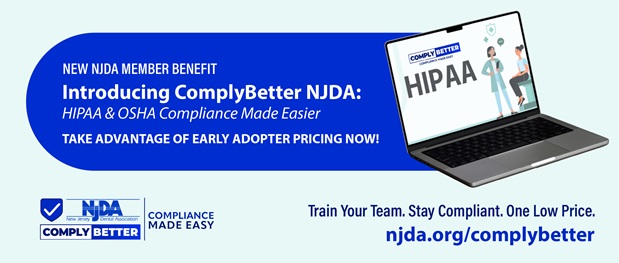
Make a Difference in Care
Help patients with special needs find a dental home. Join the NJDA’s Special Needs Provider List and connect your practice with patients and families seeking care. Sign up today.
Master Claim Appeals & Radiograph Coding
Join us November 17 at 1:00 PM for Session 4 of the Dental Claims & Coding Exchange! Dilaine Gloege, CDA, CPC, will cover claim denials and appeals plus radiograph coding and frequency limits to help your team navigate common claims and coding challenges.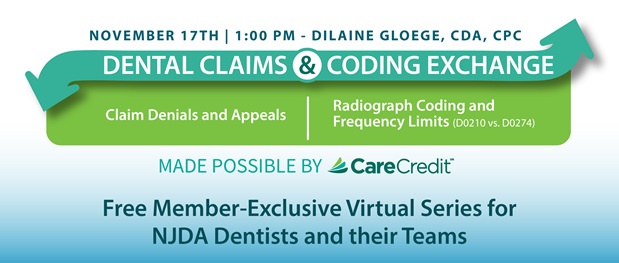
Helping Members Succeed
The New Jersey Dental Association is the voice of the dental profession and a strong proponent of oral health in the state. Members are part of a vibrant community of dentists encompassing 12 local dental societies as well as the American Dental Association. Members engage in educational programs, have access to dentist-centric relationships and tools to navigate the business of dentistry and their careers, as well as benefit from dedicated advocacy that protects the interests of the profession. The organization is run by member-dentists with the support of a team of professionals at NJDA Headquarters. NJDA members never practice alone!
UPCOMING EVENTS
Add to:
Add to:
DENTAL NEWS AND NOTES
Why NJDOL's Rulemaking Matters Beyond Labor Law
The New Jersey Department of Labor and Workforce Development finalized its worker-classification rules this month. What role did NJDA play?
When the New Jersey Department of Labor and Workforce Development finalized its worker-classification rules this month, most of the attention naturally went to the legal standard itself. The final regulations clarify how the state applies the ABC test when determining whether a worker is properly classified as an independent contractor or an employee, and the rules are scheduled to become operative on October 1, 2026. NJDOL has framed the final rule as guidance rooted in longstanding statute and case law, including the New Jersey Supreme Court’s decisions in Carpet Remnant Warehouse and East Bay Drywall. Read about it here.
But for organized dentistry in New Jersey, the bigger story is not just the rule itself. It is the role advocacy played in shaping the final outcome and why relationships with the broader business community matter so much in a state where regulatory complexity can have real consequences for employers. Dental practices are healthcare providers, but they are also small businesses. They hire teams, contract for services, manage overhead, and make daily operational decisions inside one of the most regulated business environments in the country. When state agencies propose rules that affect employment relationships, compliance obligations, and business risk, dentistry has a stake in that conversation not only as a profession, but as part of New Jersey’s larger employer community.
That is why this moment is worth paying attention to.
When NJDOL first proposed these regulations in April 2025, the department said the rules would codify its interpretation of the ABC test and provide employers with detailed guidance for applying it under laws including the Unemployment Compensation Law, Wage and Hour Law, and Wage Payment Law. The department also made clear from the beginning that the proposal was meant to combat worker misclassification while preserving the status of genuine independent contractors. From the state’s point of view, the proposal was about clarity and enforcement. From the business community’s point of view, however, the proposal also raised concern that the regulations would lock in some of the strictest interpretations of the ABC test and make an already difficult compliance environment even harder to navigate.
That concern was not abstract. During the public process, NJDOL extended the comment period from 60 days to 90 days and held a public hearing. By the time the rule reached final adoption, the department acknowledged it had received thousands of comments and said the final regulations incorporated significant feedback from the business community that led to meaningful changes. The New Jersey Business & Industry Association (NJBIA), which strongly opposed the rule, said there were more than 9,500 public comments in opposition and credited broad business and stakeholder engagement for producing several revisions to the proposal. Even where there was disagreement over the final result, there is little doubt that advocacy made an impact.
That is an important point because advocacy is not always about stopping a rule entirely. Sometimes it is about improving what is proposed, narrowing harmful language, and forcing clearer guardrails into the final version.
In this case, there is evidence that organized pushback mattered. In the adoption notice, NJDOL expressly said it was adding a new subsection to address concerns about statutory exemptions. The final rule now states that nothing in the chapter should be construed to alter or eliminate statutory exemptions under the covered laws. That language was not in the original proposal. The department also removed proposed Prong C language that said the relevant question was not whether someone was free to work for others, but whether the person actually did perform services for and receive remuneration from others during the relevant period. For businesses and independent contractors, those changes are meaningful because they reduced some uncertainty and softened at least part of the more rigid language contained in the proposal.
At the same time, the final rule did not become a business-community rewrite. NJBIA has continued to argue that while some revisions were made, the final regulations still codify the strictest interpretations of Prongs B and C drawn from New Jersey Supreme Court precedent. NJDOL, by contrast, maintains that it is not creating a new test at all, but explaining one that has already been part of New Jersey law for decades. Both of those things can be true in a practical sense. The legal standard may not be new, but formal regulations can still shape how employers understand risk, how agencies enforce the law, and how businesses make staffing decisions going forward.
That distinction matters for dentistry.
For New Jersey dentists, this issue is not really about entering a broader ideological debate over labor policy. It is about the practical reality that business owners need clear rules. In a small healthcare practice, uncertainty can be expensive. Employers need to know how the state interprets the law, where the lines are, and what the compliance expectations will be. They also need confidence that the state understands the operational realities facing professional practices and small employers. That is why organized dentistry benefits from being in relationship with other business voices that are paying attention to the same regulatory environment.
Groups like the NJBIA and the New Jersey Chamber of Commerce matter in moments like this because they help create a broader coalition around issues of business clarity, predictability, and fair implementation. Dentists may approach these issues through the lens of healthcare delivery, but they still experience them as employers, taxpayers, and small business operators. When the business community raises concerns about regulatory uncertainty, organized dentistry has a natural reason to be part of that conversation.
That broader advocacy ecosystem also includes political relationships. NEW JOBS PAC, the New Jersey Organization for a Better State, describes itself as a nonpartisan, pro-business political action committee that supports candidates who back economic growth, private-sector job creation, and lower business costs. In 2025, it endorsed 68 candidates in 36 legislative districts for the General Assembly election. Whether the issue is labor rules, tax policy, workforce policy, or the regulatory climate more broadly, those relationships matter because organized business interests do not wait until the very end of the process to speak. They build influence over time, maintain channels of communication, and create opportunities to be heard when the stakes are high.
That is the real advocacy lesson here.
The final worker-classification rule was not withdrawn. The business community did not get everything it wanted. But that does not mean the advocacy failed. In fact, the public record suggests the opposite. Advocacy extended the process. Advocacy generated a major volume of public feedback. Advocacy forced the department to respond directly to business concerns. Advocacy appears to have helped secure revisions that reduced at least some uncertainty in the final text. That is not a total policy win, but it is a real example of why organized engagement matters.
For organized dentistry in New Jersey, that is the takeaway worth emphasizing. Our work is not only about clinical regulation or oral health policy. It is also about making sure dentists are represented in the larger conversations that shape the business environment in which they practice. Dentists are healthcare professionals, but they are also employers and small business owners. In a state that is often challenging for businesses, clarity in the rules is not a side issue. It is central to stability, planning, and growth.
This is why our relationships matter. They matter with policymakers. They matter with statewide business organizations. They matter with coalitions that understand how regulations affect employers on the ground. And they matter with pro-business advocacy structures that help ensure business voices are heard before a proposal becomes final.
In the end, this moment is about more than worker-classification rules. It is about the value of organized advocacy itself. When businesses speak early, clearly, and together, they can shape the conversation, improve the outcome, and make sure the final rules are better than they otherwise would have been. For New Jersey dentistry, that is not someone else’s fight. That is part of our work too.

QUICK LINKS











Contact Us
Phone: 732-821-9400 or dial the Staff Directly
Fax: 732-821-1082 | Email: info@njda.org | Follow us @NJDentalAssoc
One Dental Plaza, North Brunswick, NJ 08902
