
Add to:
Fall Membership Drive
Get a jump start on 2027 - join local, state, and national now with no payment until January!
Your Next Chapter Starts Here
Get expert guidance for selling, buying, or transitioning your dental practice. Schedule a complimentary consultation and take your next step with confidence.
Save Time & Money on Dental Compliance
Provide flexible online training for the entire team, create required HIPAA and OSHA manuals and documentation, access compliance resources and more for one low price. Through December 31, 2026, New Jersey dental offices can take advantage of Early Adopter pricing on the first year of ComplyBetter NJDA.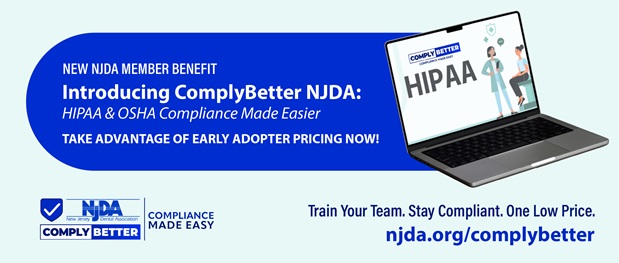
Make a Difference in Care
Help patients with special needs find a dental home. Join the NJDA’s Special Needs Provider List and connect your practice with patients and families seeking care. Sign up today.
Master Claim Appeals & Radiograph Coding
Join us November 17 at 1:00 PM for Session 4 of the Dental Claims & Coding Exchange! Dilaine Gloege, CDA, CPC, will cover claim denials and appeals plus radiograph coding and frequency limits to help your team navigate common claims and coding challenges.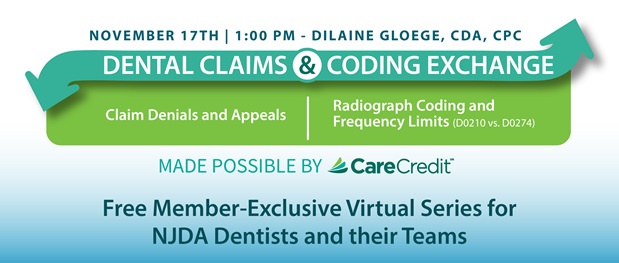
Free CE for NJDA Members
NJDA members, don’t miss New Jersey Day at the Greater New York Dental Meeting on Sunday, November 29! GNYDM welcomes members and their staff to take advantage of special FREE CE opportunities! Registration now open!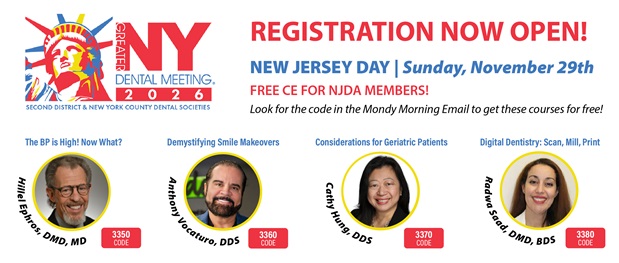
Helping Members Succeed
The New Jersey Dental Association is the voice of the dental profession and a strong proponent of oral health in the state. Members are part of a vibrant community of dentists encompassing 12 local dental societies as well as the American Dental Association. Members engage in educational programs, have access to dentist-centric relationships and tools to navigate the business of dentistry and their careers, as well as benefit from dedicated advocacy that protects the interests of the profession. The organization is run by member-dentists with the support of a team of professionals at NJDA Headquarters. NJDA members never practice alone!
UPCOMING EVENTS
Add to:
Add to:
DENTAL NEWS AND NOTES

A case study in escalation: A restorative follow-up gets complicated
What began as a rather straightforward follow-up procedure quickly escalated into a patient’s complex request for a refund and access to their medical records. This case study demonstrates how the situation unfolded, where the breakdown in communication and protocols occurred and what the dentist should have done differently to prevent escalation.

Whether due to miscommunication, procedure complications, unmet patient expectations or other unforeseen circumstances, having the occasional unsatisfied patient comes with the territory in any dental office.
While the scenario may be unavoidable, how you choose to manage the situation can significantly influence the outcome. A thoughtful, proactive approach can help de-escalate concerns, while missteps may intensify them and increase risk. A recent call to The Dentists Insurance Company highlights how quicky a situation can spiral when appropriate measures are not taken. It also outlines what key steps to follow to mitigate your risks.
Refund request, then demand for $30K in compensation: A case study
TDIC’s Risk Management Advice Line recently received a call from a dentist regarding a patient who had an implant placed by a traveling periodontist at their office.
When the patient returned for follow-up restorative care for an abutment and crown, the dentist was unable to perform the treatment because the implant was mobile. The patient left the appointment upset that the planned treatment could not be performed and demanded a refund. The dentist agreed to refund the amounts paid by both the patient and their dental benefits plan.
Several days later, the patient returned to the office with a new demand and requested additional compensation of $30,000. The patient stated that in addition to the loss of the implant, he now noticed that his speech was also becoming affected.
The dentist offered to redo the implant after the area had fully healed or provide a referral to another provider who could replace the implant. The patient restated his demand for monetary compensation and explained that replacement of the implant was insufficient to address the damages he had suffered.
Shortly after this exchange, the patient sent a formal letter to the practice requesting a copy of his records, a detailed explanation of what went wrong during treatment and a proposed plan to resolve the matter. This letter specified a 14-day response deadline, as well as a request for compensation beyond the original demand, including an allegation that he should now be compensated for his additional damages and the costs of future treatment.
On day 13 of the 14-day response window, the dentist contacted TDIC’s Advice Line seeking guidance on how to proceed. The dentist shared that they were not planning to provide the patient with the requested records until he paid the $50 record duplication fee that their office charges all patients who request a copy of their records. TDIC’s risk management analyst shared the advice highlighted below.
TDIC’s advice on de-escalating to mitigate risk
The case study illustrates several critical moments where the dentist could have made different decisions that would have reduced tension without compromising legal or ethical obligations.
What happened: During the initial follow-up appointment when the dentist was unable to perform the treatment due to the mobile implant, the patient became upset and requested a refund. The dentist agreed to refund the amounts paid by both the patient and their dental benefits plan. The patient agreed to consider this offer and left the office.
TDIC’s advice: Dental practices must have clear policies and procedures stating when patients will or will not receive a refund. When evaluating specific scenarios, reference the guidelines first rather than being pressured to decide in the moment. Additionally, in the process of offering a refund, sit down with the patient one-on-one to listen to and understand their concerns or frustrations more clearly. As this case study demonstrates, offering a refund alone may not necessarily resolve patient dissatisfaction. When underlying concerns are not fully addressed, patients may continue to escalate their demands.
What happened: The office refused to provide the patient with the records they requested until the record duplication fee was paid.
TDIC’s advice: TDIC’s risk management analysts advise that all patients are entitled to timely access to a copy of their records, regardless of whether they pay duplication fees. Delaying or refusing to provide records until a fee is paid may increase patient frustration and escalate conflict. It can also result in legal and regulatory risks.
Offices must support the basis for any charges by referring to the fee requirements and regulations enforced by their state. TDIC’s resource Access to Patient Records and Retention Guidelines outlines these requirements and fees with state-specific considerations. TDIC policyholders can sign in to use the guidelines. Learn more about documentation best practices in TDIC’s Patient Records Essentials Guide.
Dentist-patient communications lead to resolution
During the call, the TDIC analyst suggested that the dentist reach out to the patient a final time to determine if the patient’s frustrations largely stemmed from disappointment with the implant failure. The dentist stated that up to this point he felt that he had a good relationship with the patient and that the patient seemed to trust his prior treatment recommendations.
The dentist followed the analyst’s advice and contacted the patient. After hearing the patient’s frustrations, he agreed that he could have communicated the risks of implant failure more clearly. The dentist was able to reach a mutually agreeable resolution with the patient, providing him an additional amount for his “inconvenience.” However, the amount agreed to was significantly lower than the patient had previously requested.
Tense patient situations, particularly those involving refunds or record requests, can get out of hand more quickly than you may expect. This case study shows how small decisions can greatly impact how a patient chooses to proceed. Having clear procedures, communicating clearly and effectively with the patient and prioritizing de-escalation can all help you manage your risk while maintaining patient trust.
TDIC’s Risk Management Advice Line is a benefit to TDIC policyholders. To schedule a consultation with an experienced risk management analyst, visit tdicinsurance.com/RMconsult or call 1.877.269.8844.

QUICK LINKS











Contact Us
Phone: 732-821-9400 or dial the Staff Directly
Fax: 732-821-1082 | Email: info@njda.org | Follow us @NJDentalAssoc
One Dental Plaza, North Brunswick, NJ 08902
