
Add to:
New Member Benefit Coming Soon
NJDA is excited to announce a new member benefit at the November 4 House of Delegates Meeting… watch this short video (0:45) for a hint!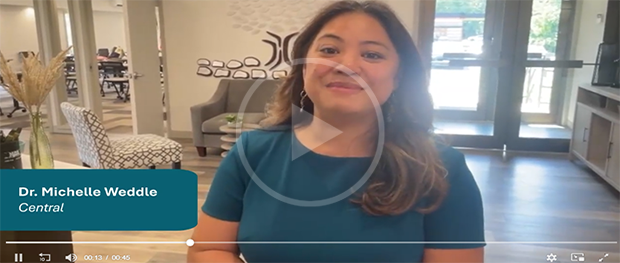
Innovation, Education & Connection at GNYDM 2026!
Explore the latest dental innovations, earn CE, network, and register FREE!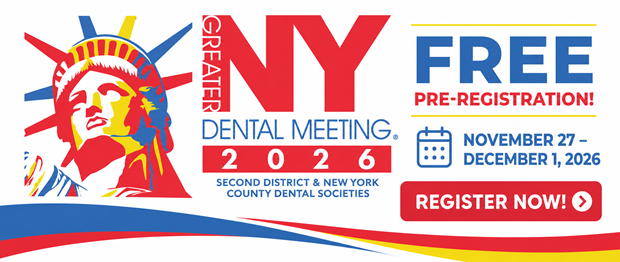
Fall Membership Drive
Get a jump start on 2027 - join local, state, and national now with no payment until January!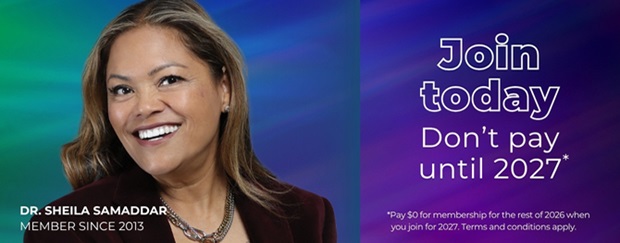
Save Time & Money on Dental Compliance
Provide flexible online training for the entire team, create required HIPAA and OSHA manuals and documentation, access compliance resources and more for one low price. Through December 31, 2026, New Jersey dental offices can take advantage of Early Adopter pricing on the first year of ComplyBetter NJDA.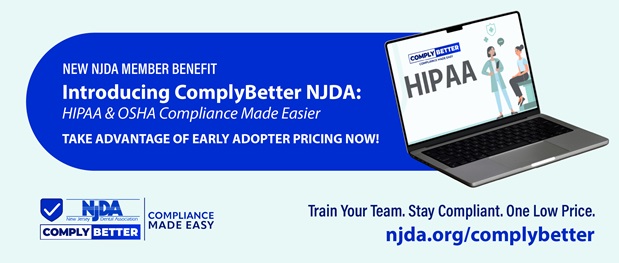
Make a Difference in Care
Help patients with special needs find a dental home. Join the NJDA’s Special Needs Provider List and connect your practice with patients and families seeking care. Sign up today.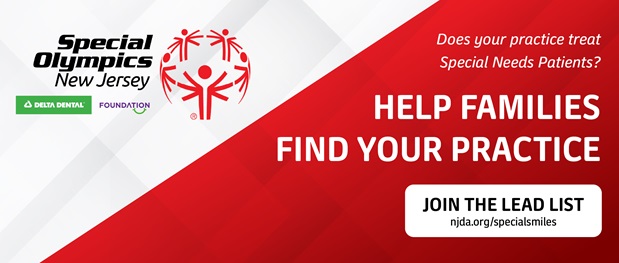
Master Claim Appeals & Radiograph Coding
Join us November 17 at 1:00 PM for Session 4 of the Dental Claims & Coding Exchange! Dilaine Gloege, CDA, CPC, will cover claim denials and appeals plus radiograph coding and frequency limits to help your team navigate common claims and coding challenges.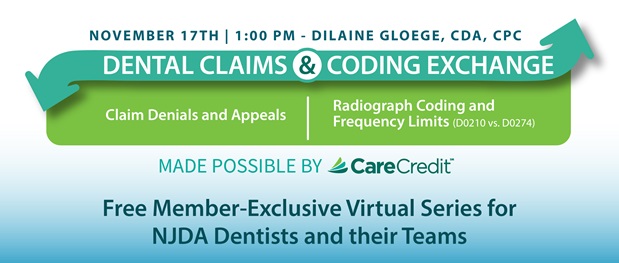
Helping Members Succeed
The New Jersey Dental Association is the voice of the dental profession and a strong proponent of oral health in the state. Members are part of a vibrant community of dentists encompassing 12 local dental societies as well as the American Dental Association. Members engage in educational programs, have access to dentist-centric relationships and tools to navigate the business of dentistry and their careers, as well as benefit from dedicated advocacy that protects the interests of the profession. The organization is run by member-dentists with the support of a team of professionals at NJDA Headquarters. NJDA members never practice alone!
UPCOMING EVENTS
Add to:
Add to:
DENTAL NEWS AND NOTES
Fighting for Dentists in Trenton: What NJDA Put on the Record This Month
NJDA was in Trenton this month to advocate for dentists on nine legislative items - and none of them were "dental" bills - and all would effect your practice.
In two legislative days this month, NJDA went on the record on nine items that were not dental bills - and asked for things that would change what a dentist gets paid, how a contract can be changed, and who decides a dental appeal. None of them had the word "dental" in the title. All of them affect your practice.
This is a shift in how your association shows up in Trenton. Our flagship work - the Dentist and Dental Hygienist Compact, dental loss ratio reporting, the Donated Dental Services appropriation - continues. But most of what happens to dentistry in the Legislature happens inside bills about something else: a public employee health plan, a Medicaid oversight program, an EMT training pathway, a licensing board for nursing home administrators. If we are not in the room when those move, the dental piece gets written by someone who has never run a practice. So we are in the room, and this is what we said.
Why we file on bills that aren't dental bills
Every committee hearing in Trenton has a stack of witness slips. A slip is one page: who you are, which bill, support or oppose, and whether you want to speak. It costs nothing. It does three things. It puts NJDA's position in the committee record, where staff and sponsors see it when the bill is amended. It tells the sponsor that dentists noticed their bill, which matters the next time we need something from that office. And when the slip comes with a one-page statement and a specific ask, it plants an idea - a sentence that says "apply this to the State Board of Dentistry" or "dental assisting needs this same pathway" - that becomes the opening line of a conversation months later.
We don't file on everything. The test is whether a bill does one of three things: changes what a dentist is paid or how; changes who can practice, where, and how fast they can get licensed; or changes whether a patient can get to a dentist at all. Those are the two systems that have to work for dental access to work - the workforce and the insurance economics - and the safety net that catches people when they don't. If a bill touches one of them, we're on it.
S4438: a new health plan for every school employee in New Jersey, with nothing in it for dentists - until we showed up
S4438, sponsored by Senator Vin Gopal, would create a single statewide trust to provide medical, prescription, dental, and vision coverage for every public school and county college employee in the state, starting January 1, 2028. It is backed by NJEA. It had a discussion-only hearing in Senate State Government on October 15, which is the moment when a bill's shape gets set, and NJDA testified.
Here is what we found when we read all 21 sections. The trust would be governed by a ten-member board with no clinical seat. It would almost certainly self-fund, which puts it outside ERISA and outside the state insurance code - meaning prompt-pay rules, the 18-month limit on recoupments, the independent appeals program, and the 2023 dental claims law would not reach it. Provider appeals would go to a medical board made up entirely of physicians. The statute spells out the medical benefit down to the $10 copay and says nothing about dental. And buried in the actuarial data: SEHBP's own dental plan for active employees paid only $1.4 million in claims last year, which means most school employees get dental today through plans their districts buy locally - the contracts many of you hold.
We asked for six things. The one we led with is new ground for NJDA: a Dental Reimbursement Adequacy and Patient Access Standard written into the statute. An independent annual assessment of whether what the trust pays dentists is enough to sustain a network - and when it isn't, a legal duty on the board to adopt a corrective plan with timelines. Not a study. A duty. Alongside it: 90 days' written notice before any fee reduction, no automatic rate cuts when contracts move into the trust, protection against your contracted rates being leased to third parties without your consent, and a network-gap rule so that when the trust can't deliver a dentist, the patient sees one out of network at in-network cost and the dentist is paid a disclosed, benchmarked rate.
We also asked that a licensed dentist sit on the board that decides dental appeals; that prompt-pay, no-fee electronic payment, coding review, and the 18-month recoupment limit be written in; that the trust publish a dental loss ratio for every dental arrangement it runs; and that the sponsor settle whether local district dental plans survive at all.
Senator Gopal's office has our comments and draft statutory language for every ask. Members should know what this is: NJDA asking a public purchaser, in writing, for an enforceable floor under the economics of treating its beneficiaries. We framed it as patient access, because it is. But it was written for you.
A3066: making the State keep the dental promises it already made to nursing home patients
A3066, sponsored by Assemblyman Chris Tully, requires DHS to review the Medicaid Managed Long-Term Services and Supports program - the part of NJ FamilyCare that covers nursing facility residents and homebound adults - and to publish an annual report card on each managed care organization. Dental is not mentioned anywhere in the bill. NJDA testified in Assembly Health Infrastructure on October 15 in support, with amendments.
The argument we made is one the State can't easily refuse. The NJ FamilyCare managed care contract already requires every MCO to maintain a dental network that can treat medically complex patients, to offer urgent dental appointments within 24 hours and routine ones within 28 days, and to provide special-needs members up to four visits a year without prior authorization, including care in the facility. Those are promises the State has already extracted from the MCOs. Nobody checks whether they're kept. New Jersey leads the nation on adult Medicaid dental utilization statewide - about 32 percent in 2022 by the ADA's count - but no public source can say whether a nursing home resident has seen a dentist.
So we asked that the review measure it, and that it look at the provider side: whether reimbursement and administrative requirements actually support the dentists who bring portable equipment into a facility, and how each MCO and its dental administrator handle claims, denials, prior authorization, audits, and recoupments. We asked that the report card include dental utilization, verified appointment availability, claim payment timeliness, denial rates, and provider appeals - and that when an MCO's dental access falls short, DHS require a corrective plan, including payment changes where payment is the barrier. We asked that care managers, who the bill sends to the bedside more often, ask about dental pain and broken dentures and follow the referral through. And we flagged a drafting problem in Section 3 that would have sunset the bill's own improvements - a favor to the sponsor that bought us a hearing for the rest.
Thirty-six percent of New Jersey dentists participate in Medicaid, against 51 percent in Pennsylvania. The ones who treat MLTSS patients do the hardest work in the program for the least certainty of payment. This bill is where we asked the State to count them.
H.R. 1: what Medicaid coverage loss due to the One Big Beautiful Bill looks like from the chair
On October 22, Senate Health held an invited-guest hearing on New Jersey's implementation of the federal budget law, H.R. 1. The witnesses were hospitals, insurers, and advocates talking in hundreds of thousands. NJDA submitted a statement, joined by Dr. Lisman - former State Dental Director, 45 years at Newark Beth Israel, and for years the operator of one of the largest Medicaid dental practices in the state - that talked about one patient and one crown.
The State's own numbers: about 25,000 non-citizen adults received documentation letters on October 1, and those who couldn't establish eligibility lost everything, including dental. On January 1, roughly 540,000 expansion adults - the adult dental population - go onto work requirements and six-month redeterminations, with the first terminations in March. DHS projects 165,000 to 330,000 members could lose coverage by 2030, many of them still eligible but caught in paperwork. And from January, the retroactive coverage window for expansion adults drops from three months to one.
For a dental office, that last change is the one that lands. A root canal started under coverage and a crown that can't be seated. A denture fabricated while the patient is eligible and delivered after the lapse. A claim denied for a patient who was covered last month. The patient goes without treatment; the dentist did the work for nothing; and the next time, that dentist doesn't take the case. That is how a network thins, and we said so.
We asked for four things: that DHS count dental in whatever tracking it builds for H.R. 1 - utilization, dental emergency department visits, claim denials tied to eligibility, and dentists leaving the network; that the State maximize automatic renewals, give practices a way to verify coverage dates, and examine state options for protecting treatment already in progress; that the Legislature restore the Donated Dental Services line item that was left out of this year's budget; and that adult oral health be on the list when the State renews its Medicaid waiver next year, including an emergency-department-to-dentist referral pilot.
The slips: five bills, one dental sentence each
These got a support slip and a one-page statement. None is a dental bill. Each one has a sentence in the record that we will come back to.
Bill | What it does | The dental sentence we put on the record |
A476 (Rodriguez) | EMT training from age 16, taught in school, provisional certification, free in exchange for local service | Dental assisting needs this exact pathway; the age-18 licensure rule blocks our CTE pipeline |
A4309 (Speight) | 90-day licensing deadlines, default approval if the board misses them, immediate approval for out-of-state licensees in good standing - for nursing home administrators | This is the template we want at the State Board of Dentistry |
A1321 (Miller, Speight) | Revise the State pandemic plan | Count dentists as surge and vaccination capacity in advance, as the State did by emergency order during COVID |
A3116 (Swain, Verrelli) | Nurse aide recruitment and training reimbursement | Aides deliver daily oral care in facilities; put oral hygiene in the curriculum |
SJR108 (Gopal) | Veterans Month | Most New Jersey veterans have no path to dental care; NJDA will bring the Committee options |
Two of these are worth watching. Assemblywoman Speight is the sponsor of A4309 and chairs the Assembly Aging and Human Services Committee, which heard NJDA's statement on oral health in addiction recovery the same day - three touches with one office in one morning, and a door opened on dental licensing timelines. And A476's age-16 pathway is the model for the dental assisting fix we've wanted for years; we told the sponsor so, in writing.
What's next: A3257 and the contract you signed
A3257, sponsored by Assemblymen Hutchison and Miller and Assemblywoman Simmons, is one sentence long: a carrier cannot change a provider contract to reduce reimbursement during the contract's term. That is the single most common complaint NJDA hears from members - the fee schedule that changed mid-year, the CDT code that got reassigned, the contract that was leased to a network paying less. The bill was posted for a hearing this week and the meeting was canceled, which gave us time to fix a problem.
As drafted, the bill supplements a law whose definition of "carrier" is built around medical insurers. It may not reach stand-alone dental plans at all - the dental service corporations and dental plan organizations that hold most of your contracts. We sent all four sponsors, in both houses, a one-page amendment that borrows the carrier definition the Legislature already wrote into the 2014 non-covered services law, and that defines "reduce reimbursement" to include fee schedule changes, code reassignments, bundling and downcoding, and network leasing. Optionally, 90 days' notice before a renewal on reduced terms, with a right to decline.
If that definition goes in, this bill does for every dentist with a commercial contract what we asked S4438 to do for school employee plans: it makes the contract you signed the contract you get. We'll report when it's re-posted.
What you can do
Three things, none of which take more than ten minutes.
Tell us when it happens to you. A mid-contract fee cut, a recoupment demand two years after treatment, a patient whose coverage lapsed between the root canal and the crown, a revalidation letter you almost missed. The asks above are built on what members report; the next ones will be too. Use the Member Inquiry Form with the carrier, the date, and what happened.
If your legislator is on this list, say thank you. Senator Gopal, Assemblymen Tully, Rodriguez, Hutchison, and Miller, Assemblywomen Speight, Simmons, Swain, and Donlon, and Assemblyman Verrelli all have NJDA statements on their desks this month. A dentist in the district who says "I saw what NJDA sent you, and it matters to my practice" is worth more than anything we can send.
Give to NJDPAC. The reason a sponsor's office takes a call from NJDA before a bill is re-posted is that we are in the room all year. That costs money, and it is the best money a practice can spend in Trenton. Contribute at njda.org/dental-advocacy/political-actionnjda.org/dental-advocacy/political-action.
And watch for calls to action from omorales@njda.org - when a bill is posted, a member email to the right office in the right week is what moves it. The full testimony on S4438, A3066, and the H.R. 1 hearing, and every statement filed this month, are available from the Advocacy and Health Affairs department. Read the S4438 comments if you read one thing. It is the clearest statement NJDA has made of what fair reimbursement looks like in law, and it was written with your practice in mind.
QUICK LINKS




Contact Us
Phone: 732-821-9400 or dial the Staff Directly
Fax: 732-821-1082 | Email: info@njda.org | Follow us @NJDentalAssoc
One Dental Plaza, North Brunswick, NJ 08902
