
Add to:
A Night All About Your Future
Join NJDA’s 4th annual Cocktails & Career Conversations on August 13 for a fun, laid-back evening of craft cocktails, networking, and real-world career insights designed for dentist who are just getting their start. Connect with peers, grow your network, and explore your next steps. Click to learn more about the event, pricing, and to register.
Raise a Glass to New Connections!
Join fellow early-career dentists for NJDA's Fall New Dentist Happy Hour- an evening of great conversations, new connections, and a well-deserved chance to unwind. Reconnect with classmates, expand your professional network, and enjoy a fun night with colleagues who understand the journey. We can't wait to see you there!
Don't Miss Session 3!
Join speaker Dilaine Gloege, CDA, CPC, for an informative session covering two common dental billing and coding challenges. Learn how to respond to insurer clawbacks and retroactive denials, and gain clarity on when and how to properly use CDT "By Report" codes with the documentation needed to support your claims.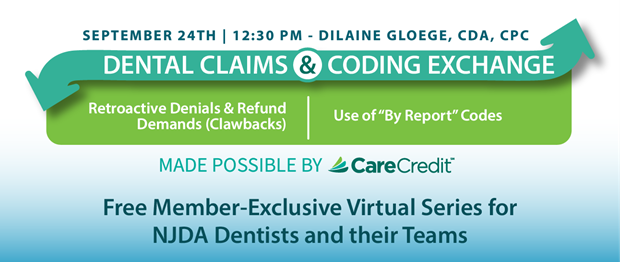
Refer A Friend, Get Rewarded
Each One, Reach One is happening now! Share your personal referral number and earn free CE when your friend becomes a member.
Enhance Your Membership
Customize your 2026 membership by adding the virtual License Requirements Series, our Practice Solutions bundle, or the new Dental Impact Series!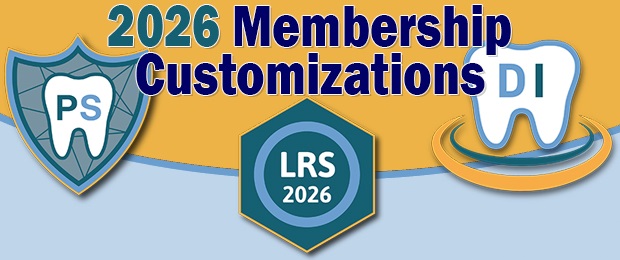
Helping Members Succeed
The New Jersey Dental Association is the voice of the dental profession and a strong proponent of oral health in the state. Members are part of a vibrant community of dentists encompassing 12 local dental societies as well as the American Dental Association. Members engage in educational programs, have access to dentist-centric relationships and tools to navigate the business of dentistry and their careers, as well as benefit from dedicated advocacy that protects the interests of the profession. The organization is run by member-dentists with the support of a team of professionals at NJDA Headquarters. NJDA members never practice alone!
UPCOMING EVENTS
Add to:
Add to:
DENTAL NEWS AND NOTES
Aetna to End Paper Checks for Out-of-Network Dentists: What New Jersey Dentists Should Know
Aetna plans to stop issuing paper checks and paper explanations of benefits to out-of-network dentists beginning Sept. 4, 2026, prompting concerns from the ADA and NJDA about how the change will affect New Jersey providers.
New Jersey law protects payment choice, while federal rules protect access to standardized electronic payment and remittance transactions
The American Dental Association (ADA) reports that Aetna plans to discontinue paper checks for out-of-network dentists. The ADA has urged Aetna to reconsider the change because it may conflict with payment-choice laws in several states (ADA, 2026).
The ADA advises dentists with concerns to contact Aetna, review applicable state laws and consider contacting their state insurance regulator. The ADA is also working with state dental associations as the issue develops (ADA, 2026).
The New Jersey Dental Association (NJDA) has received multiple member inquiries concerning Aetna notices scheduled to take effect September 4, 2026. NJDA is also seeking clarification from Aetna about the payment and remittance options that will remain available to New Jersey out-of-network dentists.
What Aetna’s notice says
An Aetna provider notice dated July 6, 2026, and reviewed by NJDA states that paper checks and paper explanations of benefits will be discontinued beginning September 4, 2026. The notice advises that providers who do not enroll in electronic funds transfer, or EFT, may receive payments through virtual credit cards, or VCCs (Aetna provider notice, July 6, 2026).
The notice also states that “contracted dental providers may select the payment delivery method of their choice, including check payments” (Aetna provider notice, July 6, 2026).
The language reviewed by NJDA does not clearly explain whether out-of-network dentists may continue to receive paper checks. The ADA separately reports that Aetna has announced it will discontinue checks for out-of-network dentists (ADA, 2026).
NJDA has asked Aetna to confirm the payment options available to New Jersey OON dentists and to explain how providers may select or change their payment method.
What does New Jersey law require?
New Jersey’s provider-payment-choice law is P.L. 2023, c.247, codified at N.J.S.A. 17B:30-34.1.
For OON providers, New Jersey law provides that a carrier or its contracted vendor may not restrict an OON provider furnishing covered OON services “to only one form of payment” (N.J.S.A. 17B:30-34.1(b)).
The statute identifies credit card, EFT and check as examples of payment methods. It also defines “health care provider” to include a dentist and defines “credit card” to include a single-use or virtual credit card (N.J.S.A. 17B:30-34.1(h)).
When an available payment method has an associated fee, the carrier or its vendor must notify the provider that fees may apply and disclose fees beyond those the provider would normally incur when processing that particular type of payment (N.J.S.A. 17B:30-34.1(c)(1)).
The carrier must also provide clear instructions explaining how the provider may select each available payment method (N.J.S.A. 17B:30-34.1(c)(2)).
When a provider requests a change among the available payment methods, the carrier generally must implement the selected change within 30 business days, subject to state and federal fraud-prevention verification requirements (N.J.S.A. 17B:30-34.1(d)).
The statute prohibits carriers from considering a provider’s preferred payment method when making credentialing decisions. It also provides that its protections cannot be waived by contract (N.J.S.A. 17B:30-34.1(e)–(f)).
Does New Jersey law guarantee paper checks?
The final law does not expressly require carriers to continue offering paper checks.
Although the statute lists check as an example of a payment method, it prohibits restricting an OON provider to only one payment method. It does not state that check, EFT and credit card must each be offered (N.J.S.A. 17B:30-34.1(b)).
Earlier versions of the legislation would have required carriers to offer all reasonably available payment methods, including check and EFT. That language was replaced before enactment with the current prohibition against offering only one payment method (A4913, Second Reprint).
Based on the final language, NJDA’s current interpretation is that offering both VCC and EFT could satisfy the statute’s basic requirement that an OON dentist not be restricted to only one payment method. The statute does not expressly state that this particular combination is sufficient, so NJDA is asking Aetna to confirm its interpretation and implementation.
Aetna must still ensure that both options are genuinely available, properly disclose applicable fees, provide clear selection instructions and timely implement a provider’s request to change among the available options.
Must one of the payment methods be fee-free?
New Jersey law does not expressly require that at least one payment method be free.
Instead, the statute anticipates that an available payment method may have an associated fee and establishes disclosure requirements when fees apply (N.J.S.A. 17B:30-34.1(c)).
Aetna’s public provider information states, “We won’t charge you a fee for EFT, but your bank might.” Aetna also states that medical and dental providers may enroll in EFT through Optum’s Payer Enrollment Services (Aetna, accessed July 23, 2026).
NJDA is asking Aetna to confirm that this statement applies to OON New Jersey dentists and that neither Aetna nor its enrollment vendor imposes an enrollment, subscription, transaction, reassociation or other vendor charge for basic ACH EFT.
Why virtual credit cards may be costly
The ADA explains that VCC payments are processed through credit card networks rather than through the HIPAA-adopted ACH EFT standard. Because VCC transactions are generally subject to card-processing fees, the ADA states that dentists are more likely to incur fees when accepting VCC payments than when receiving standardized ACH EFT payments (ADA, 2026).
The ADA has also received complaints that some third-party payment vendors charge for additional services bundled into the enrollment process, including automatic reassociation, expedited payment and practice-management integration (ADA, 2026).
Based on the ADA’s guidance, NJDA recommends that dentists review EFT enrollment agreements carefully and ask specifically for a basic ACH EFT option without unwanted or optional paid services (ADA, 2026).
Dentists should also ask their financial institutions whether the bank charges a fee for incoming ACH payments. The ADA explains that a fee imposed independently by the dentist’s bank is separate from a fee imposed by the carrier or its payment vendor (ADA, 2026).
Why is NJDA citing CMS for a commercial dental plan?
The Centers for Medicare & Medicaid Services (CMS) is relevant here not because these are Medicare claims, but because CMS’s National Standards Group administers and enforces the federal HIPAA Administrative Simplification standards governing electronic claims, payments and remittance transactions.
CMS explains that the standards apply to HIPAA-covered health plans, clearinghouses and providers conducting electronic administrative transactions. For HIPAA purposes, health plans include private health insurance companies, HMOs, employer-sponsored health plans and government health programs (CMS, 2026).
CMS also states that the adopted standards apply to covered entities “not just those who accept Medicare or Medicaid” (CMS, 2026).
Accordingly, the federal EFT and ERA requirements can apply to commercial carriers such as Aetna when the carrier or plan is acting as a HIPAA-covered health plan. Specific exceptions may apply to certain arrangements, but network participation is not a condition of the federal EFT and ERA protections.
Federal law gives providers the right to request standardized ACH EFT
Federal regulations provide that when an entity asks a health plan to conduct a covered transaction as a standard transaction, the health plan must do so (45 C.F.R. § 162.925(a)(1)).
The federal regulations adopt the NACHA CCD+ Addenda format and related X12 specifications for standardized ACH EFT payments, along with the X12 835 standard for remittance advice (45 C.F.R. § 162.1602).
CMS states that when a provider requests that a health plan make payment through the ACH Network using the adopted EFT standards, the plan must comply. The provider must complete the plan’s applicable enrollment process (CMS, 2022).
CMS also expressly states that a provider does not have to participate in the health plan’s network to receive standardized EFT and ERA transactions (CMS, 2022).
Federal HIPAA rules do not require a health plan to honor a provider’s request for a paper check. CMS explains that the federally required payment method, when properly requested, is ACH EFT—not paper check (CMS, 2022).
Can a health plan or payment vendor charge for EFT?
CMS states that charging a fee for an EFT or ERA transaction is not, by itself, automatically prohibited under HIPAA. CMS also explains, however, that conditioning access to standardized EFT or ERA transactions on a provider’s acceptance or purchase of unwanted payment or reassociation services may be considered an attempt to adversely affect the provider or transaction (CMS, 2022).
This means the federal rules do not establish a simple rule that every ACH EFT must be free. Nevertheless, a carrier should not make receipt of the standard transaction dependent on purchasing unwanted value-added services.
New Jersey law separately requires disclosure of fees associated with the available payment methods (N.J.S.A. 17B:30-34.1(c)).
What about the elimination of printed EOBs?
NJDA has not identified a New Jersey statute or regulation that expressly requires a carrier to mail a printed provider EOB or remittance statement for every claim.
New Jersey’s prompt-payment regulation requires a carrier that denies or disputes a claim to notify the provider of the basis for its decision. The notice must identify and explain the reasons for the denial or dispute, identify required missing information, explain disputed amounts or coding changes and provide a telephone number for questions (N.J.A.C. 11:22-1.6).
The regulation does not expressly establish a general right to have all provider payment and remittance information delivered through a mailed paper EOB. This is NJDA’s interpretation of the current regulation, not an express statement by the Department of Banking and Insurance.
The elimination of printed EOBs does not necessarily mean that a practice must manually retrieve every claim explanation from Aetna’s portal.
What is an electronic remittance advice?
CMS defines an electronic remittance advice, or ERA, as an explanation from a health plan to a provider concerning a claim payment. An ERA describes payment processing and adjustments involving issues such as benefit coverage, secondary payers, copayments and coinsurance (CMS, 2026).
The federally adopted ERA standard is X12 Version 5010 835. CMS explains that matching trace information in the ACH payment and the associated ERA helps practices reassociate the payment with the correct remittance information (CMS, 2026).
When a provider requests remittance information in the standard X12 835 format, CMS states that the health plan must comply with that request (CMS, 2022).
CMS also states that posting remittance information to a web portal does not replace the plan’s obligation to transmit the standard 835 transaction when the provider requests it. The provider may request delivery directly or through a clearinghouse acting on the provider’s behalf (CMS, 2022).
Aetna’s public provider page states that medical and dental providers can enroll in ERA through Optum’s Payer Enrollment Services. Aetna separately makes electronic EOBs available through the Availity portal (Aetna, accessed July 23, 2026).
Based on the federal guidance, NJDA recommends that practices concerned about manually retrieving EOBs ask Aetna about enrollment in the standardized X12 835 ERA and whether the transaction can be delivered to the practice’s clearinghouse or practice-management system.
Steps New Jersey dentists should consider
Based on the authorities and guidance described above, NJDA recommends that dentists who receive an Aetna notice:
Confirm whether the notice applies to participating or OON providers. The notice reviewed by NJDA preserves check payments for contracted dentists but does not clearly describe the options available to OON dentists.
Ask Aetna for a written list of every payment method available to the practice. New Jersey law requires clear instructions for selecting each available method (N.J.S.A. 17B:30-34.1(c)(2)).
Decline VCC payments in writing when the practice does not wish to incur merchant-processing fees.
Request the basic HIPAA-standard ACH EFT transaction. CMS states that a health plan must comply with a proper request for standardized ACH EFT (CMS, 2022).
Ask whether Aetna or its enrollment vendor imposes any fees. Aetna states that it does not charge for EFT, although the provider’s bank may charge a fee (Aetna, accessed July 23, 2026).
Review the enrollment agreement before accepting optional services. The ADA advises dentists to check for paid services bundled with EFT enrollment (ADA, 2026).
Request X12 835 ERA delivery to the practice or its clearinghouse rather than relying solely on portal retrieval (CMS, 2022).
Retain copies of the notice, enrollment terms, communications and documentation of fees. These materials may help NJDA or regulators evaluate whether Aetna’s implementation complies with applicable requirements.
Send NJDA any notice or response that specifically addresses OON dentists. This will help NJDA evaluate whether Aetna is offering more than one genuine payment method and meeting the law’s disclosure and selection requirements.
NJDA continues to seek clarification
NJDA has contacted Aetna to determine whether New Jersey OON dentists will continue to have access to paper checks, whether basic ACH EFT is available without a fee imposed by Aetna or its contracted vendor, and how dentists may receive standardized ERA transactions.
NJDA’s current interpretation is that eliminating paper checks may not, by itself, violate N.J.S.A. 17B:30-34.1 if Aetna offers OON dentists more than one genuine payment method. Aetna must nevertheless comply with the statute’s requirements concerning payment choice, fee disclosure, selection instructions and timely changes to a provider’s selected method.
This remains a developing matter. NJDA will update members when additional information becomes available from Aetna or the ADA.
This article is provided for general educational and informational purposes and does not constitute legal advice. The application of state and federal requirements may depend on the particular plan, funding arrangement, claim, transaction and payment process involved.
Sources
“ADA Calls Out Aetna for Limiting Payment Options for Out-of-Network Dentists.” American Dental Association, ADA News, July 22, 2026.
“Claim Payments and Explanations of Benefits Are Going Digital.” Aetna Dental provider notice, July 6, 2026. Notice reviewed by NJDA; no public link available.
P.L. 2023, c.247, codified at N.J.S.A. 17B:30-34.1, “Health Care Provider, Carrier, More Than One Method of Payment, Reimbursement; Definitions.” New Jersey Legislature, approved January 8, 2024.
A4913, Second Reprint. New Jersey Legislature, 2022–2023 legislative session.
“About Administrative Simplification.” Centers for Medicare & Medicaid Services, last modified May 27, 2026.
“Adopted Standards and Operating Rules.” Centers for Medicare & Medicaid Services, last modified March 16, 2026.
45 C.F.R. § 162.925, “Additional Requirements for Health Plans.” U.S. Department of Health and Human Services, electronic Code of Federal Regulations.
45 C.F.R. § 162.1602, “Standards for Health Care Electronic Funds Transfers and Remittance Advice Transactions.” U.S. Department of Health and Human Services, electronic Code of Federal Regulations.
“Operating Rules EFT and Remittance Advice.” Centers for Medicare & Medicaid Services, last modified June 9, 2026.
“Guidance Letter 2022-04—Health Plans’ Payment of Health Care Claims Using Virtual Credit Cards and Adopted HIPAA Standards for EFT and ERA Transactions: Frequently Asked Questions.” Centers for Medicare & Medicaid Services, July 14, 2022.
“Go-to-Answers: Frequently Asked Questions.” Centers for Medicare & Medicaid Services, last modified March 16, 2026.
“Electronic Payment and Remittance for Providers.” Aetna, publication date not provided; accessed July 23, 2026.
N.J.A.C. 11:22, “Prompt Pay Regulations.” New Jersey Department of Banking and Insurance, publication date not provided; accessed July 23, 2026.

QUICK LINKS






Contact Us
Phone: 732-821-9400 or dial the Staff Directly
Fax: 732-821-1082 | Email: info@njda.org | Follow us @NJDentalAssoc
One Dental Plaza, North Brunswick, NJ 08902
