
Add to:
Fall Membership Drive
Get a jump start on 2027 - join local, state, and national now with no payment until January!
Your Next Chapter Starts Here
Get expert guidance for selling, buying, or transitioning your dental practice. Schedule a complimentary consultation and take your next step with confidence.
Save Time & Money on Dental Compliance
Provide flexible online training for the entire team, create required HIPAA and OSHA manuals and documentation, access compliance resources and more for one low price. Through December 31, 2026, New Jersey dental offices can take advantage of Early Adopter pricing on the first year of ComplyBetter NJDA.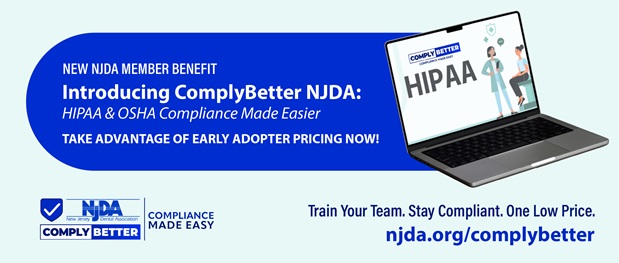
Make a Difference in Care
Help patients with special needs find a dental home. Join the NJDA’s Special Needs Provider List and connect your practice with patients and families seeking care. Sign up today.
Master Claim Appeals & Radiograph Coding
Join us November 17 at 1:00 PM for Session 4 of the Dental Claims & Coding Exchange! Dilaine Gloege, CDA, CPC, will cover claim denials and appeals plus radiograph coding and frequency limits to help your team navigate common claims and coding challenges.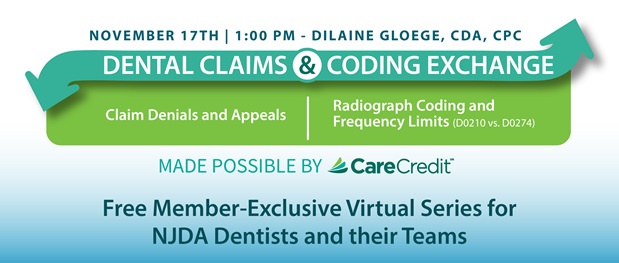
Free CE for NJDA Members
NJDA members, don’t miss New Jersey Day at the Greater New York Dental Meeting on Sunday, November 29! GNYDM welcomes members and their staff to take advantage of special FREE CE opportunities! Registration now open!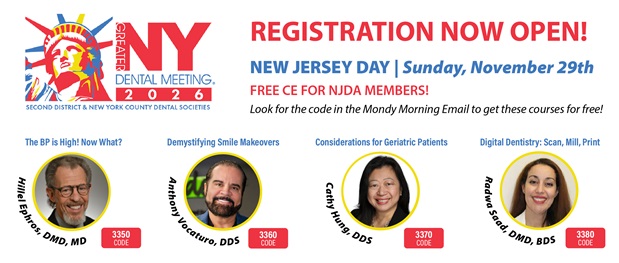
Helping Members Succeed
The New Jersey Dental Association is the voice of the dental profession and a strong proponent of oral health in the state. Members are part of a vibrant community of dentists encompassing 12 local dental societies as well as the American Dental Association. Members engage in educational programs, have access to dentist-centric relationships and tools to navigate the business of dentistry and their careers, as well as benefit from dedicated advocacy that protects the interests of the profession. The organization is run by member-dentists with the support of a team of professionals at NJDA Headquarters. NJDA members never practice alone!
UPCOMING EVENTS
Add to:
Add to:
DENTAL NEWS AND NOTES
Think before you hit record: Two case studies in dental office video surveillance
Article Provided by TDIC. Surveillance cameras are becoming more common in dental offices. Be aware of the HIPAA and privacy regulations surrounding their use, as well as basic recording guidelines for practice owners.
In our digital world, video recordings have become normalized at every turn, whether via our smartphones, our doorbells or even satellites miles above the earth. But what does this mean for the dental office?
Surveillance cameras in dental offices are becoming increasingly common. The driving force behind them is typically security, as cameras can aid in loss control, deter theft and discourage other criminal activity. But cameras are not without their drawbacks.
The do's and don’ts of video surveillance
Prior to installing or using video cameras, practice owners should be aware of the laws and regulations surrounding their use. While laws vary from state to state, some basic guidelines include the following:
- DO inform patients that cameras are in use. If used in the reception area, this can be done with a simple sign. If used in operatories, have patients sign an acknowledgment and release form.
- DON’T record audio—only video. Many states have strict laws against eavesdropping.
- DO inform all employees, in writing, that cameras are in use. You do not need their permission, but you do need a signed acknowledgment, which should be kept in their employee file.
- DON'T place cameras in areas where there is a reasonable expectation of privacy, such as restrooms or changing rooms.
- DO have a consistent policy in place on how recordings may be used and how long to keep them.
HIPAA and privacy rules are important to consider when installing cameras. Ensure that cameras aren’t pointed in a direction where they can capture a computer screen with a patient’s private information. Patients can also often feel uncomfortable being recorded, so be prepared to turn off the camera if requested to do so. Be sure to document this in the patient’s chart.
Case study: A parking lot incident caught on camera
If using cameras, it’s also crucial for practice owners to consider who has access to the recordings. This is true for recordings taken both inside and outside of the practice. If an exterior camera captures a patient entering the office, that alone is considered private health information and must be protected.
In one case reported to The Dentists Insurance Company’s Risk Management Advice Line, a patient backed into a parked car in the parking lot after leaving her appointment. She drove off without leaving a note, as required in California, which is a misdemeanor hit-and-run. Because the dental office's windows faced the parking lot, the car's owner came into the office and inquired if they witnessed who had hit his car.
Upon reviewing the surveillance footage, the dentist saw that the incident occurred and confirmed that it involved one of his patients. The owner of the damaged vehicle requested to view the footage and asked for the patient’s contact number. The dentist called the Advice Line seeking guidance on how to handle the situation.
The risk management analyst reminded the dentist of his obligation to report the incident to law enforcement. She also advised that he should reach out to the patient, inform her of the footage and suggest that she contact the damaged vehicle’s owner. Additionally, he was advised to let the patient know that should law enforcement ask to view the footage, he must comply.
“In an effort to protect privacy, it is not a good idea to universally allow someone to view footage when asked. There are precautions to consider, such as other patients who may be visible in the footage or staff who may not have consented to release footage containing their images."
Case study: The nuances of recording patient treatment
In another case reported to TDIC’s Advice Line, an 8-year-old autistic patient was seen for fillings. The dentist used a papoose board to stabilize the child. The child’s mother was not in the operatory during treatment. The patient became uncooperative and the assistant began to tap the patient’s head, a successful technique they had used in the past to calm autistic patients.
The dentist was able to complete the treatment. Upon dismissing the patient to his mother, she explained to her that though the child was uncooperative, they were able to complete the scheduled treatment. A few hours later, the patient’s father showed up to the office with pictures of his child on his cell phone, furious because the child had a bruise under his eye.
The father noticed that the office had a surveillance camera and demanded to see the footage. The dentist allowed him to view it. He became even more upset when he saw that the assistant was tapping his child’s head and felt that this may have contributed to the child’s anxiety levels increasing. He expressed that the office should be familiar with and have the skills to manage autistic patients appropriately. He told the dentist that she would be hearing from his attorney and stormed out of the office.
The dentist called the Advice Line to ask whether she was required to turn over the footage to the patient’s father. The analyst advised the dentist that the video is part of the patient record; therefore, she must ensure that it does not include information pertaining to other patients or staff.
Similarly, there are situations where patients may request to record treatment. TDIC advises against allowing patients to record treatment as other patients or employees could inadvertently be recorded without consent.
“A video of a patient undergoing an exam or treatment is considered protected health information under HIPAA, and under the law it must be treated as such."
Video surveillance can be a proactive way for practice owners to protect their patients and themselves. They can also pose unexpected risks if used without caution. By following a few basic guidelines, it is possible to benefit from video cameras while at the same time keeping the private health information of patients and employees just that—private.
TDIC’s Risk Management Advice Line is a benefit to TDIC policyholders. To schedule a consultation with an experienced risk management analyst, visit tdicinsurance.com/RMconsult or call 1.877.269.8844.

QUICK LINKS








Contact Us
Phone: 732-821-9400 or dial the Staff Directly
Fax: 732-821-1082 | Email: info@njda.org | Follow us @NJDentalAssoc
One Dental Plaza, North Brunswick, NJ 08902
