
Add to:
Member Input Needed
Learn about a proposed new approach to supporting insurance participation, reimbursement, credentialing, and more at a Regional Member Meeting this month.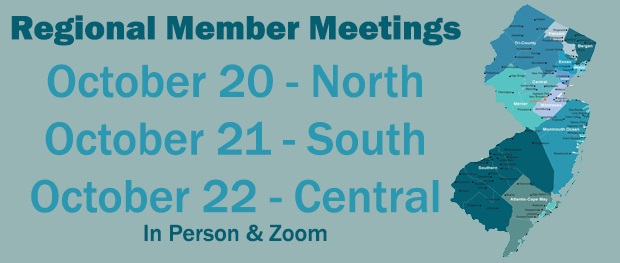
New Member Benefit Coming Soon
NJDA is excited to announce a new member benefit at the November 4 House of Delegates Meeting… watch this short video (0:45) for a hint!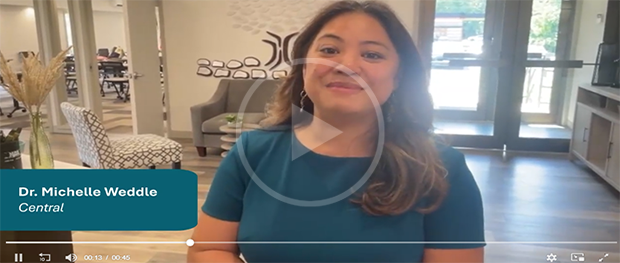
Innovation, Education & Connection at GNYDM 2026!
Explore the latest dental innovations, earn CE, network, and register FREE!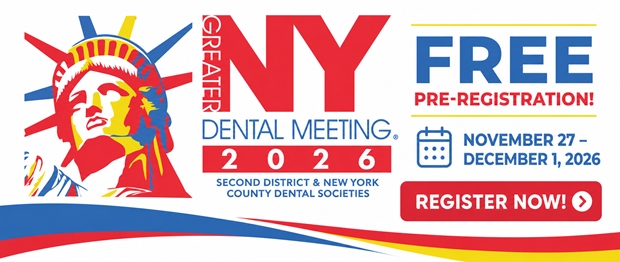
Fall Membership Drive
Get a jump start on 2027 - join local, state, and national now with no payment until January!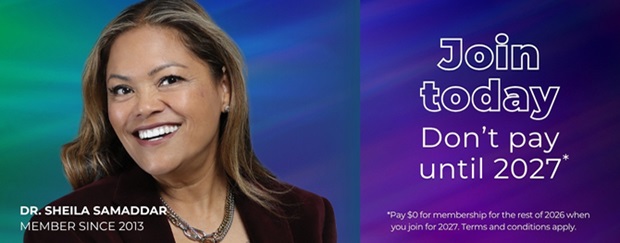
Save Time & Money on Dental Compliance
Provide flexible online training for the entire team, create required HIPAA and OSHA manuals and documentation, access compliance resources and more for one low price. Through December 31, 2026, New Jersey dental offices can take advantage of Early Adopter pricing on the first year of ComplyBetter NJDA.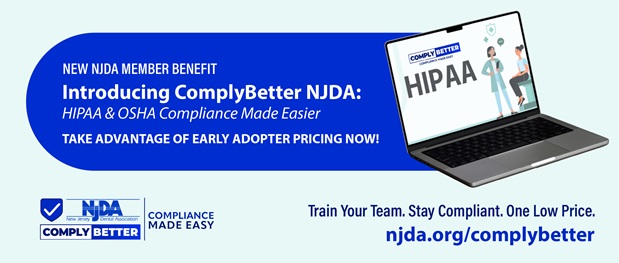
Make a Difference in Care
Help patients with special needs find a dental home. Join the NJDA’s Special Needs Provider List and connect your practice with patients and families seeking care. Sign up today.
Master Claim Appeals & Radiograph Coding
Join us November 17 at 1:00 PM for Session 4 of the Dental Claims & Coding Exchange! Dilaine Gloege, CDA, CPC, will cover claim denials and appeals plus radiograph coding and frequency limits to help your team navigate common claims and coding challenges.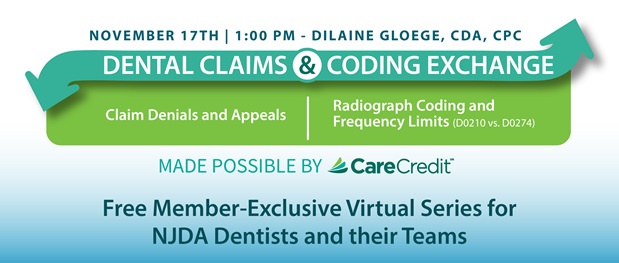
Helping Members Succeed
The New Jersey Dental Association is the voice of the dental profession and a strong proponent of oral health in the state. Members are part of a vibrant community of dentists encompassing 12 local dental societies as well as the American Dental Association. Members engage in educational programs, have access to dentist-centric relationships and tools to navigate the business of dentistry and their careers, as well as benefit from dedicated advocacy that protects the interests of the profession. The organization is run by member-dentists with the support of a team of professionals at NJDA Headquarters. NJDA members never practice alone!
UPCOMING EVENTS
Add to:
Add to:
DENTAL NEWS AND NOTES
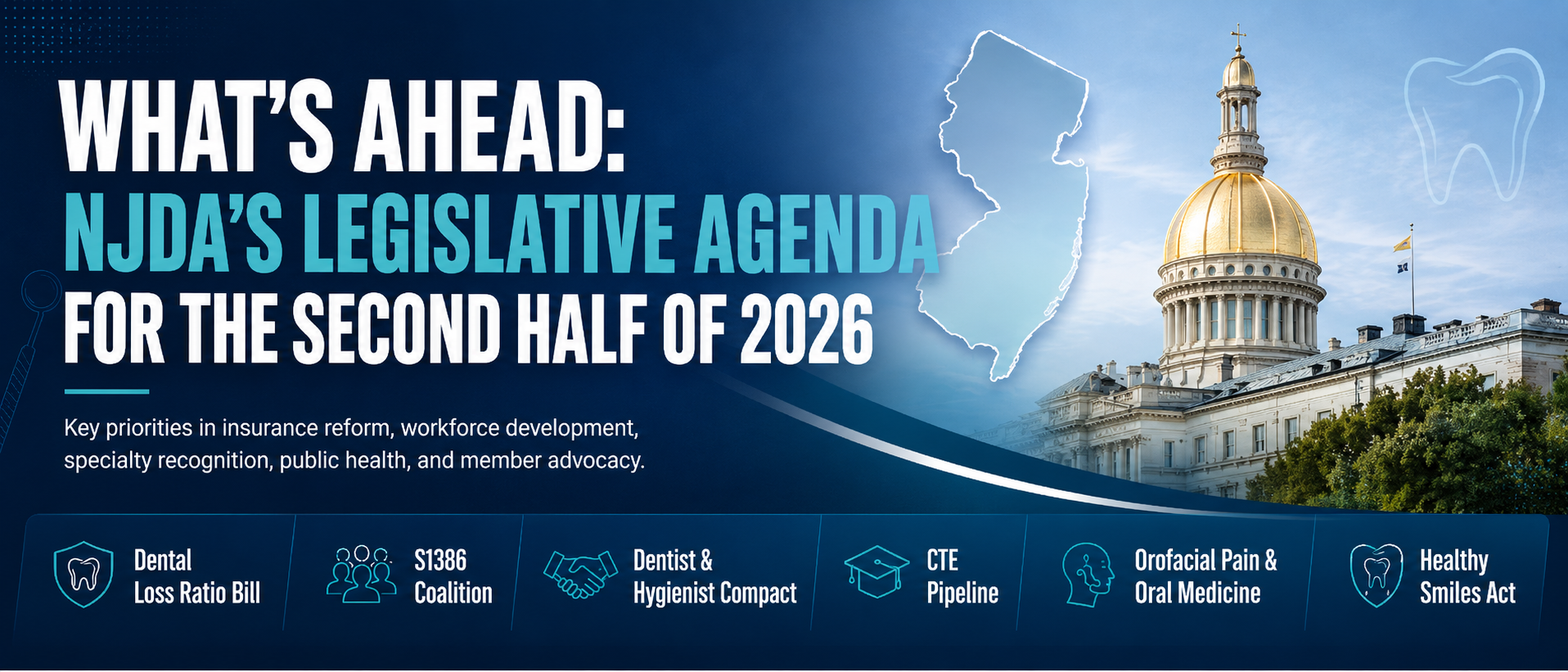
What's Ahead: NJDA's Legislative Agenda for the Second Half of 2026
What is NJDA pursuing between now and the end of the year, and where will participation from member-dentists matter most?
The first half of this session established position. The second half is where members are going to be asked to act. Below is what NJDA is pursuing between now and the end of the year, and where your participation will matter most.
Before the specifics, here is the frame that ties our issues together in the eyes of legislators. New Jersey's dental access problem is not one failure. It is two. The workforce system cannot supply enough licensed professionals to meet demand, and the insurance system does not reimburse at a level that makes delivering care economically viable. A safety net of donated care programs, community health centers, and school-based access absorb the consequences when both fail at once. Every item below sits in one of those two systems, and none of them work in isolation.
Insurance: the Dental Loss Ratio bill is the fight that needs you
A5380, the Transparency for Dental Health Care Costs Act, is proposed for introduction in the next Assembly voting session in September. NJDA's amendments are in the bill at introduction rather than left to be won later, which is a meaningful improvement over where this stood last session. The bill is moving in the Assembly first. A Senate companion has not been introduced yet, and NJDA is working that side in parallel.
The bill requires dental carriers to report annually what share of premium dollars goes to patient care, makes that data public and comparable by carrier and plan type, and gives the Department of Banking and Insurance the ability to flag carriers that fall outside the norm. On top of that reporting structure, it sets a minimum loss ratio: 85 percent for large group plans and 83 percent for small group and individual plans, with rebates to policyholders required when a carrier misses the threshold.
It also closes a loophole worth understanding. Under the federal model, a nonprofit carrier can subtract community spending from the premium base before the ratio is calculated. That raises the reported number without a single additional dollar reaching the patients who paid those premiums. A5380 does not allow it. The ratio is measured against the full premium base. Community contributions are worth reporting, and they are not patient care.
One correction we should all make when we talk about this bill. New Jersey does have a dental loss ratio law. It applies to prepaid dental plan organizations, a small segment of the market, at tiered thresholds topping out at 80 percent. It does not apply to the commercial PPO plans that most of your patients actually carry. That is the entire gap. The problem is not that dental has no standard. It is that the standard reaches the wrong part of the market.
Why this bill is good for patients, carriers, and you
Here is the part that is easy to miss and is the most persuasive thing in the package.
A loss ratio requirement gives a carrier a direct reason to want its members in your chair. Large numbers of New Jerseyans carry dental benefits they never use. Today, an unused benefit is simply revenue the carrier keeps. Under A5380, it becomes a number the carrier has to answer for. The bill creates an incentive for insurers to close the gap between the people who have dental benefits and the people who use them.
That is not a punishment. That is alignment. Patients get care they already paid for, carriers meet a standard they can meet by driving utilization rather than by cutting anything, and practices see patients who have been sitting on unused coverage for years. This bill asks insurers to encourage their members to use the benefit they purchased. That helps all of us give patients the care they need.
The opposition, and why your district matters
This is the item that will require the most from you. Carrier opposition is expected, and it will be well resourced and well-staffed. Insurers will argue that dental is different, that reporting is burdensome, that a floor will raise premiums. Those arguments will be made in offices you have access to and they do not.
When NJDA activates the call to action on A5380, the response of members in the districts of the sponsor and the committee members is the variable that determines whether the bill gets posted for a hearing. An association letter is expected. A letter from a constituent dentist who employs 5-15 people in the district is not, and legislators know the difference. If you receive a targeted alert on this bill, it is because your legislator is in a position to move it. Please respond.
One point of framing discipline that matters, and that we ask members to carry into their own conversations: this is not an anti-insurer bill. It is a transparency bill and an invitation to insurers to put the benefit to work. The message is that patients deserve to know where their premium dollar are going, and deserve to be encouraged to use what they bought.
The limit worth understanding now, so it does not surprise anyone later: state loss ratio rules reach fully insured plans only. Self-funded employer plans are governed by federal ERISA and remain exempt. That gap is not a reason to weaken the state bill. It is the reason NJDA is simultaneously supporting the federal Improving Dental Administration Act, H.R. 7931, co-introduced by two members of the New Jersey delegation. Two levels, one problem.
Insurance: S1386 and a broader coalition
S1386 remains active in committee. The bill creates a state-supervised structure that restores competitive balance between practices and carriers on contract terms. Track 1, available on enactment, covers non-fee matters: utilization management criteria, prior authorization, credentialing standards, payment timing, claim documentation, and dispute resolution. These are the issues that generate the majority of the calls NJDA logs every week. Track 2 addresses fee matters and requires an Attorney General finding, with active state supervision built into the bill structure as the antitrust protection.
The strategic development this half is coalition. S1386 covers all licensed health care providers, not only dentists. NJDA is opening conversations with our physician and allied health counterparts, who face the same contract dynamics with the same carriers and have the same absence of any voice in the terms. A multi-profession bill carries different political weight than a dental bill, and it should. This was never only a dental problem.
Insurance: The Healthy Smiles Act
NJDA continues to support S3011/A2229, the Healthy Smiles Act, which raises New Jersey FamilyCare fee-for-service reimbursement for pediatric dental services by 20 percent, indexes it to inflation going forward, and requires managed care rates to be no less than the fee-for-service rate.
A word on why this appears here and not under a public health heading. Medicaid is routinely discussed as a public health program, adjacent to the insurance fight rather than part of it. It is not adjacent. Medicaid is a payment system, and it fails for the same structural reason commercial dental fails: reimbursement set below the cost of delivering care, with no provider voice in the terms. Same cause, different patients. Treating it as a public health program rather than an insurance system is part of why it stays unfixed, because it invites sympathy instead of accountability.
The consequence is measurable. In New Jersey, 36 percent of third graders have untreated decay, against roughly 20 percent nationally, and 15 percent need urgent care for active pain or infection. Pediatric rates have not moved in nearly two decades. This is the clearest case that reimbursement below the cost of care is not a provider complaint. It is a children's health outcome.
Workforce: The Compact and the CTE pipeline
S806/A1702, the Dentist and Dental Hygienist Compact, remains NJDA's flagship workforce priority. Members should understand precisely where the prior attempt failed: the bill passed committee and died at second reading. Committee support was never the problem. Floor scheduling was. That is why this session's work is aimed at chamber leadership and the floor path rather than committee votes alone. A competing compact framework is also in play, and NJDA supports only the version reflected in S806/A1702. NJDA is also engaging the State Board of Dentistry directly, with a September Board meeting as the target.
S3513/A2416 lowers the licensure age for radiologic technologists from 18 to 16 and adds a Career and Technical Education (CTE) pathway. This is the bill aimed at unblocking high school dental assisting programs, which today cannot prepare students for a role they are barred from holding until years after graduation.
NJDA also recognizes the constraint the bill runs into. A national standard holds that individuals under 18 should not be exposed to radiation, and NJDA is not asking anyone to set that aside. So, the work this half is about finding a path that opens the career pipeline without moving that line, including whether didactic instruction can begin at 16 while clinical application and examination follow at 18. That approach is under discussion with the Department of Environmental Protection's Board of Radiological Health.
The regulatory picture explains why this is taking the shape it is. The Division of Consumer Affairs sets the licensure age. The Board of Radiological Health sets equipment supervision rules. Neither agency has been asked to determine whether its rules are compatible for a student in a supervised CTE setting, and NJDA is pursuing that determination alongside the legislation. Supervision by a licensed dentist or hygienist is non-negotiable in every version of this.
Recognition: Orofacial Pain and Oral Medicine
The American Dental Association recognizes both Orofacial Pain and Oral Medicine as dental specialties. New Jersey has moved partway. Practitioners in Orofacial Pain can obtain a permit to advertise the specialty. Oral Medicine does not yet have that pathway.
Advertising, however, is not the barrier that matters most to patients. Recognition by dental carriers is. Until carriers recognize these practitioners as specialists who can bill appropriate CDT and medical codes, the training exists and the reimbursement does not, and patients who need a specialist cannot reach one. NJDA is pursuing recognition on both fronts: with the State Board of Dentistry on the licensure and advertising side, and with carriers on the credentialing and coding side. This is the two-system problem in miniature. We built the workforce capacity and the insurance system does not acknowledge it exists.
Public health: NJDA at the state's table
Legislation is not the only place this work happens. On July 8, NJDA participated in the New Jersey Department of Health's State Oral Health Conference, where NJDA's Director of Advocacy and Health Affairs moderated the workforce breakout session with Dr. MaryBeth Giacona of Rutgers and Zufall Health and Suzy Dyer of the Parker Family Health Center. The session put the workforce shortage in front of the people who write the state's oral health strategy, in the state's own forum, alongside the safety net providers who see the consequences first.
That matters for a reason beyond the day itself. The State Oral Health Plan is being revived, and NJDA is named in it as a contributing organization. When the state decides what oral health means in New Jersey and who is responsible for it, organized dentistry should be in the room shaping that answer rather than reacting to it afterward. Access, prevention, and workforce are not someone else's issues that happen to touch dentistry. They are dentistry. NJDA intends to keep showing up accordingly, and the conference produced follow-up work with several of the participants that is continuing now.
What we need from you
Watch for the calls to action, particularly on A5380. Respond when your district is targeted, because targeting means your legislator can actually move the bill. And route carrier problems to kpatel@njda.org. The call log is evidence, and evidence is what moves bills.

QUICK LINKS





Contact Us
Phone: 732-821-9400 or dial the Staff Directly
Fax: 732-821-1082 | Email: info@njda.org | Follow us @NJDentalAssoc
One Dental Plaza, North Brunswick, NJ 08902
