
Add to:
Member Input Needed
Learn about a proposed new approach to supporting insurance participation, reimbursement, credentialing, and more at a Regional Member Meeting this month.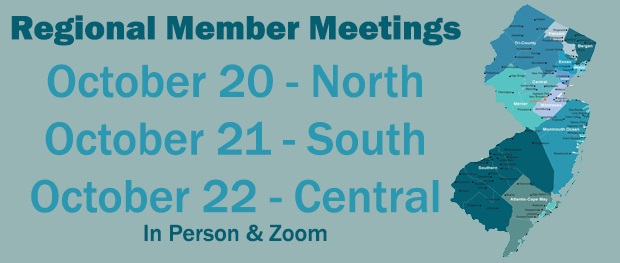
New Member Benefit Coming Soon
NJDA is excited to announce a new member benefit at the November 4 House of Delegates Meeting… watch this short video (0:45) for a hint!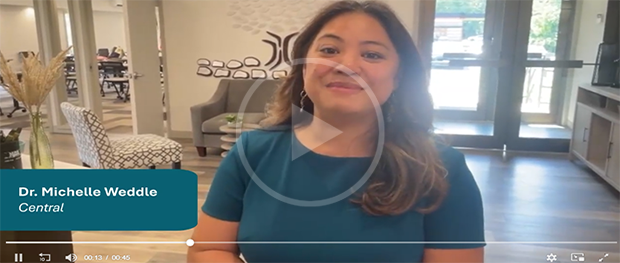
Innovation, Education & Connection at GNYDM 2026!
Explore the latest dental innovations, earn CE, network, and register FREE!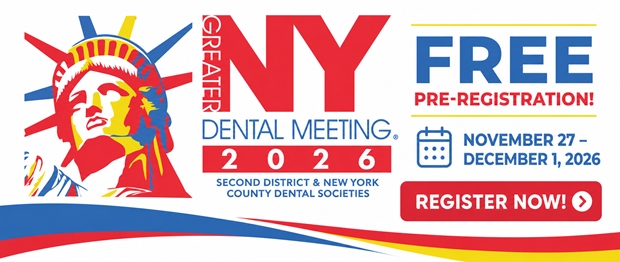
Fall Membership Drive
Get a jump start on 2027 - join local, state, and national now with no payment until January!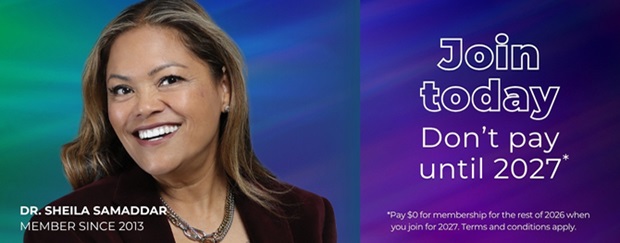
Save Time & Money on Dental Compliance
Provide flexible online training for the entire team, create required HIPAA and OSHA manuals and documentation, access compliance resources and more for one low price. Through December 31, 2026, New Jersey dental offices can take advantage of Early Adopter pricing on the first year of ComplyBetter NJDA.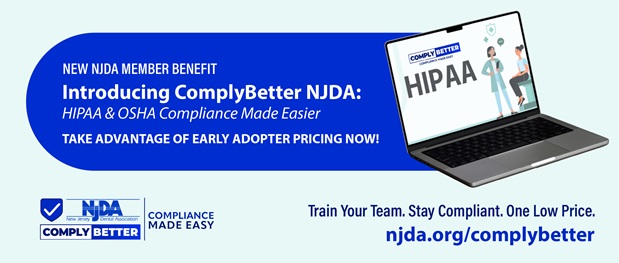
Make a Difference in Care
Help patients with special needs find a dental home. Join the NJDA’s Special Needs Provider List and connect your practice with patients and families seeking care. Sign up today.
Master Claim Appeals & Radiograph Coding
Join us November 17 at 1:00 PM for Session 4 of the Dental Claims & Coding Exchange! Dilaine Gloege, CDA, CPC, will cover claim denials and appeals plus radiograph coding and frequency limits to help your team navigate common claims and coding challenges.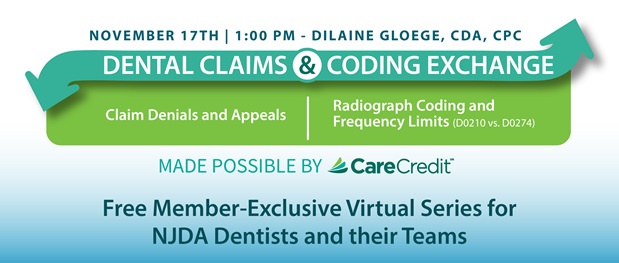
Helping Members Succeed
The New Jersey Dental Association is the voice of the dental profession and a strong proponent of oral health in the state. Members are part of a vibrant community of dentists encompassing 12 local dental societies as well as the American Dental Association. Members engage in educational programs, have access to dentist-centric relationships and tools to navigate the business of dentistry and their careers, as well as benefit from dedicated advocacy that protects the interests of the profession. The organization is run by member-dentists with the support of a team of professionals at NJDA Headquarters. NJDA members never practice alone!
UPCOMING EVENTS
Add to:
Add to:
DENTAL NEWS AND NOTES
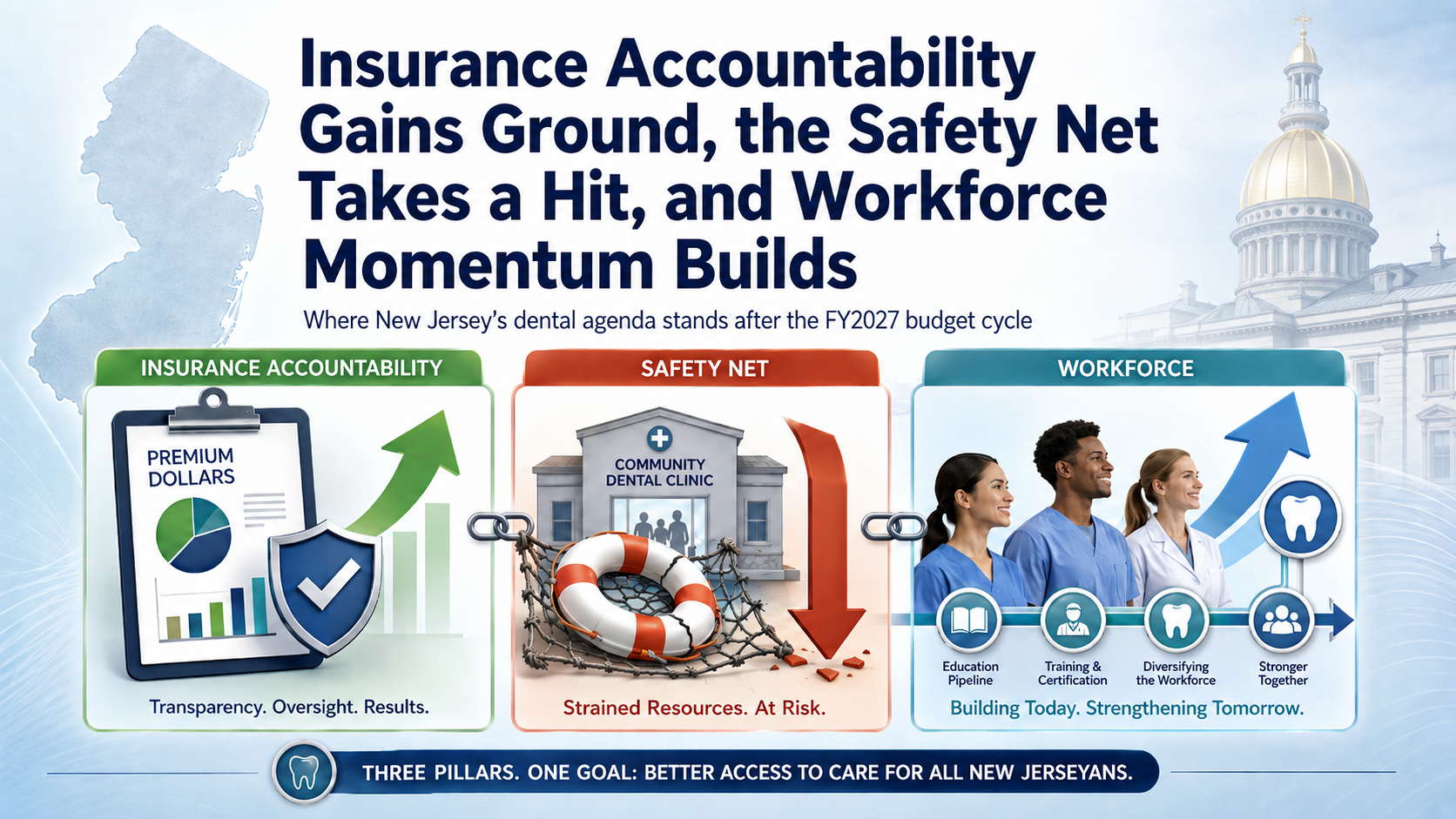
Insurance Accountability Gains Ground, the Safety Net Takes a Hit, and Workforce Momentum Builds
Where New Jersey's dental agenda stands after the FY2027 budget cycle, across workforce, insurance, and the safety net.
New Jersey's dental access problem is not one problem. It is two systems under strain at the same time, with a safety net that absorbs the damage when both fall short. The workforce cannot expand fast enough to meet demand. The insurance system too often pays below the cost of care, and it leaves patients with coverage that runs out before their needs are met. When both give way, the safety net, our donated-care programs, community health centers, and school-based access, catches who it can. Fixing one side without the other does not restore access. This budget cycle touched all three: a step forward on insurance accountability, a setback on the safety net, and building momentum on the workforce pipeline. Here is where things stand.
Insurance accountability: Dental Loss Ratio secures a bill number
For the first time, our Dental Loss Ratio (DLR) effort has a vehicle and a number. The concept, carried in the prior session as the Transparency for Dental Health Care Costs Act, has been assigned Assembly Bill 5380. Formal introduction is expected in the fall, but reaching this stage during a demanding budget cycle is real progress. DLR sits on the insurance side of our agenda.
The idea is simple and patient-forward. Dental carriers should have to show how much of every premium dollar actually reaches patient care. Medical insurance already operates under loss-ratio standards; dental does not (with exceptions of public employee dental plans). A5380 begins with transparency, mandatory reporting that lets the state and the public see where premium dollars go, and it lays the groundwork for the accountability standard we ultimately want: that a defined share, 85 cents of every premium dollar, must go to care. This is not about being against carriers. It is about giving patients and practices a clear line of sight into a product that too often functions as a capped benefit rather than true coverage.
That distinction matters because dental coverage is not working the way patients think it does. Annual benefit maximums of roughly $1,000 to $1,500 have been largely unchanged for decades while premiums have risen steadily, so families hit their ceiling mid-year and pay out of pocket for everything after. That is coverage without access, and it reaches every income level, middle-class families with employer plans as much as lower-income patients. Making the promise of coverage mean something is the equity core of this issue.
One caveat members should know. DLR reaches state-regulated, fully insured plans. Self-funded employer plans governed by federal ERISA law are exempt from state insurance rules, and that is the most common plan type many of your patients carry. That gap is exactly why NJDA also supports the federal IDA Act (H.R. 7931), co-led by New Jersey's own Rep. Van Drew and Rep. Conaway. State action for what New Jersey can regulate; federal action for what only Congress can reach.
The safety net: Donated Dental Services funding was not renewed
The safety net is what absorbs the failure when the workforce and insurance systems both fall short, and this cycle it took a hit. State support for the NJ Donated Dental Services (DDS) program was not included in the final FY2027 budget. That stings in a year when Dental Lifeline Network is marking a real milestone: nearly $30 million in donated care delivered since 1988 to New Jersey's most vulnerable residents, veterans, seniors, people with disabilities, and medically fragile patients, through hundreds of volunteer dentists, at a documented return of roughly $4.75 in care for every $1 the state invests.
DDS support is a discretionary line that has to be secured through the budget process each year. This cycle the State concentrated its limited health dollars on federally qualified health centers and other safety-net providers, positioning them ahead of anticipated federal Medicaid cuts, and amid close to $2 billion in overall reductions a standalone line like DDS did not make the final list. We are treating this as a rebuilding task, not a closed door. NJDA will support Dental Lifeline Network to bring the DDS story, the milestone numbers, and the return-on-investment case to the FY2028 process early, engaging the Department of Health and the budget committees well ahead of the markup rather than at the finish line. A program that stretches every state dollar this far, and that becomes more essential as coverage losses push more residents toward the safety net, is exactly the kind of investment a cost-conscious budget should protect.
It is worth being precise about what the budget did and did not include for oral health. Although the FY2027 budget does not restore funding for Donated Dental Services, it does contain several provisions that could affect oral-health access. The budget anticipates $617,000 in federal Oral Health Grant funding, and it provides support to safety-net providers that offer dental services, including $250,000 for Central Jersey Medical Center and $75,000 for Parker Health Clinic in Red Bank. It also increases the Health Care Subsidy Fund by $7 million over the Governor's proposal, which may strengthen federally qualified health centers that provide both medical and dental care to Medicaid, uninsured, and underserved patients. None of these appropriations is specifically dedicated to Donated Dental Services, and the budget contains no explicit Medicaid dental-rate increase. The final budget also does not continue the $200,000 FY2026 appropriation for the KinderSmile Foundation, which provides dental care and oral-health education to underserved children and families.
The workforce: a smarter path on the radiologic technologist pathway
On the workforce side, we are seeing encouraging coalition interest around the radiologic technologist licensure pathway, and the strategy has sharpened. Rather than press to lower the minimum age for radiation exposure from 18 to 16, which raises real safety and regulatory questions and would likely stall, the emerging approach is to open a career and technical education (CTE) pathway. The age-18 licensure rule currently blocks high school CTE programs from preparing students for these roles. A CTE pathway lets students begin their coursework earlier so they can move into licensure soon after graduation, without touching the exposure-age safeguards.

QUICK LINKS




Contact Us
Phone: 732-821-9400 or dial the Staff Directly
Fax: 732-821-1082 | Email: info@njda.org | Follow us @NJDentalAssoc
One Dental Plaza, North Brunswick, NJ 08902
